
UGM is a steadfast contributor to international best practices on SDGs through international collaboration and research.
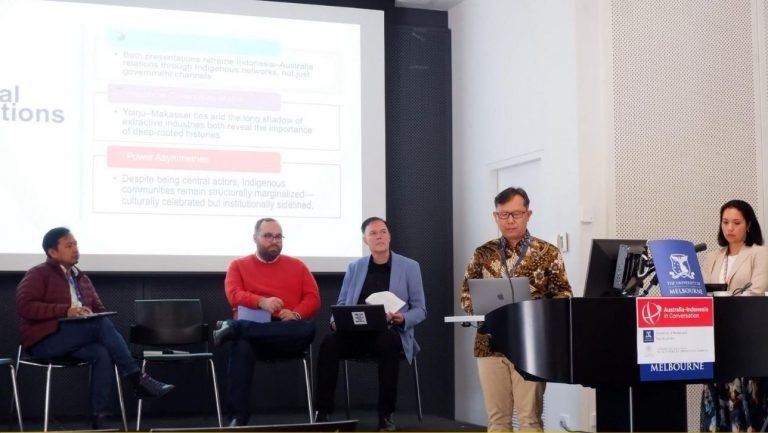
For instance, The Australia–Indonesia in Conversation (AIC), is an annual forum organized by UGM’s Faculty of Social and Political Sciences and the Faculty of Arts, University of Melbourne, since 2021. The 5th AIC brought together academics, practitioners, and indigenous community representatives from both countries to critically examine structural inequalities, sustainable development, and the role of local knowledge in policy-making. Through comparative discussions, participants explored how indigenous representation and knowledge systems in Indonesia and Australia can inform inclusive governance, environmental sustainability, and social justice. Panel sessions highlighted the importance of interdisciplinary and cross-cultural approaches, reinforcing the value of integrating traditional knowledge into modern development strategies. By facilitating comparative learning and fostering long-term collaboration, AIC contributes to developing international best practices for tackling global challenges, including inequality, sustainability, and climate resilience, thus advancing the achievement of the SDGs.
A research team from UGM, in collaboration with the University of Colorado Boulder, Penn State, Virginia Tech, the Makassar City Government, and the Bandung Institute of Technology, formed the Center for Development of Sustainable Regions (CDSR) consortium to implement a renewable energy utilization program aimed at improving community well-being and reducing carbon emissions in Makassar, South Sulawesi. Solar panels were installed in dozens of locations in the city to help lower carbon consumption. The research team reported that the solar panel installations have had a significant impact on the community, contributing to meaningful carbon reduction as part of the city’s goal to achieve net-zero emissions.
The Faculty of Geography collaborated with the CNRS Orleans Campus (France) and the University of Cambridge (England) to study the formation and evolution of magma at Mount Rinjani (Lombok) and Mount Tambora (Sumbawa). The research was led by Dr. Indranova Suhendro (UGM), along with Prof. Clive Oppenheimer (Cambridge), and a team from CNRS Orleans Campus. The team conducted field sampling at both mountains to analyze magma characteristics related to past volcanic eruptions. This study is important because major eruptions in the past (in 1257 and 1815) are directly linked to global climate change. The research results are expected to provide a deeper understanding of volcanic dynamics while supporting disaster risk mitigation policies and climate change in the future.
The Center for Child Health Studies at the Faculty of Medicine, Public Health, and Nursing collaborated with the Center for Outbreak Preparedness at Duke-NUS Medical School, Singapore to conduct wastewater monitoring research. This research aims to identify various compounds, bacteria, and potentially dangerous diseases from wastewater generated by industrial and community water use.
The Department of Agricultural Engineering and Biosystems, Faculty of Agricultural Technology has worked closely together with the Yanmar Environmental Sustainability Support Association (YESSA) from Japan for three years to develop climate-smart agrotourism in Sambak Village, Magelang Regency. Through the collaboration between UGM and YESSA, Sambak Village has experienced significant development over the past three years, coming close to fulfilling the five main elements of climate-smart agrotourism: a maintained ecological system (Ecological Systems), a community learning center (Center for Education), local food development (LoFD), recreation and education (Entertainment and Recreation), and supporting infrastructure (Infrastructure).
References:
- The Australia–Indonesia in Conversation (AIC)
- Bridging Development, Representation, and Indigenous Knowledge
- CDSR implements a renewable energy utilization program in Makassar
- International research collaboration with CNRS Orleans Campus (France) and the University of Cambridge (England)
- UGM and Duke-NUS Medical School Collaborate on Wastewater Monitoring Research
- UGM and YESSA collaboration in the development of climate-smart agrotourism in Sambak Village.