
As a guiding framework, sustainability integrates ecological balance, social equity, and economic resilience to ensure that current and future generations can thrive. UGM aims to achieve sustainability in all aspects of university administration policies.
Based on the Board of Trustees Regulation Number 1 Year 2021 concerning the Campus Master Plan (pg. 22. pg. 25), UGM is committed to providing infrastructure that is smart, healthy, comfortable, safe, and sustainable. This includes the development of a green campus with minimal carbon emissions, achieved through programs such as zero-waste initiatives, recycling, reuse, the use of renewable energy, and the promotion of environmentally friendly behaviours.
UGM has several circular letters regarding sustainability/climate action, most of which are available on the Circular Letter Regarding the Implementation of SDGs at UGM webpage.
Policies on Environmentally Responsible Behavior
Environmentally responsible behaviour within the campus community is essential to fostering sustainability. Campuses such as UGM can reduce their carbon footprint and conserve natural resources. Campuses consume large amounts of energy, water, and materials. Environmentally conscious behavior—such as energy conservation, waste reduction, and sustainable transportation—helps minimize this depletion of resources.
In order to fortify and encourage environmentally responsible behaviour, UGM has put in place several policies that apply to all students and staff. Without the existence of university policies, sustainability efforts may be inconsistent and short-lived. Regulations create a formal commitment that integrates environmental responsibility into campus operations, research, and student life.
Most recently, UGM has published the Circular Letter Number 16839/UN1.P/HK.02/2024 which outlines the guidelines and commitments to foster environmentally responsible behaviour within the university community, with a specific emphasis on carbon management and the adoption of clean energy solutions. It aims to promote sustainable practices among students, faculty, and staff as part of the institution’s efforts to reduce greenhouse gas emissions, lower its ecological footprint, and contribute to global environmental sustainability.
Circular Letter Number 1797/UN1.P/KJM_BU/2020 on Sustainable Lifestyle served as a precursor regulation to the current regulation.
Policies on Campus Waste Management
Effective campus waste management is equally critical. Campuses produce large amounts of paper, plastic, electronic, and organic waste. Proper waste management in institutions of higher education such as UGM will minimize landfill waste, pollution, and greenhouse gas emissions. Not to mention, recycling and composting programs help reduce the ecological footprint of the university.
The latest regulation is Appeal No. 3206/UN1.P5/BMS/TR.01.03/2025 1 concerning Campus Waste Management in UGM’s Central Office. The appeal details the placement of trash bins in the building and the process of sorting the waste into three categories. In addition, all work units in the Central Office must appoint a staff to manage waste in their respective work units, who are then tasked with disposing of waste from the work unit to a temporary waste storage area south of the KPU. Waste disposal time is carried out every working day at 15.00 to 15.30 WIB.
This appeal supports the Rector’s Circular Letter Number 9034/UN1.P/OT.01.03/2024. This regulation mandates all university units to comply with campus waste management policies, reinforcing the necessity of food waste tracking within UGM’s sustainability framework.
The Vice-Rector for Human Resources and Finance previously issued Circular Letter Number 6627/UN1.P4/PL.00.00/2024 on waste reduction. This regulation emphasizes efforts to reduce waste in food and beverage services and encourages the use of reusable or biodegradable materials and discourages single-use plastics in campus activities.
This policy is a follow up to Circular Letter Number 8846/UN1.P.V/Dit-Aset/TR.01.02/2023 on Waste Management, which details guidelines for organic waste management, including food waste, within the university. These guidelines include schedules for organic waste collection and regular monitoring and measurement of waste quantities. By tracking the origins and amounts of organic waste, including food leftovers, UGM can collect accurate measurements for identifying departments or units generating significant waste. On a daily basis, UGM operates according to the Standard Operating Procedure on waste disposal management.
Food Waste Management is a critical part of climate action on campus. Good food waste management is able to mitigate Greenhouse Gas Emissions, since food waste contributes to methane emissions in landfills, which is a potent greenhouse gas. Secondly, food production consumes a significant amount of water, energy, and land. Minimizing food waste helps conserve these resources. Food waste management also encourages circular economy practices, as composting food waste supports soil health and reduces reliance on chemical fertilizers.
In 2026, our university launched the UGM IoT Scale for Waste Program. All 20 faculties and schools are equipped with a digital scale to weigh the amount of organic, non-organic, and residue waste, as well as leaf waste, produced by faculties each month. Using IoT, the total amount of waste in the university can be monitored and pinpoint the facilities producing the most amount of waste. This data is the first step to reducing waste and creating the proper management strategies. The IoT scale was developed by a dedicated team from our very own Faculty of Engineering. The team conducted feasibility studies in March 2026 at each faculty to determine the best location of each scale. The system will be in place by and begin operating in May 2026.
Policies on UGM Campus Transportation
Following the University’s Master Plan regarding Campus Transportation stated in Rector’s Decree Number 911 Year 2018, UGM is dedicated to lowering carbon dioxide emissions by applying three concepts (pg. 8) which are 1) Prioritizing pedestrians and cyclists, 2) One Gate Campus protocol which restricts the use of motorized vehicles on campus, and provides parking lots and campus buses, and 3) creating a Better Campus Network that involves the integration of UGM campus transportation with city transportation services.
Policies on Upgrading Campus Buildings to Higher Energy Efficiency
Strategic plans are in the works to upgrade existing buildings to higher energy efficiency. By integrating sustainable practices and fostering green behaviour, UGM aims to align its infrastructure with global standards, supporting its Strategic Plan 2022–2027 for a greener, more sustainable campus. This includes obtaining certifications in energy efficiency for its campus buildings.
The university appoints a designated Person-in-Charge (PIC) in each faculty to monitor the energy consumption of their faculty buildings and participate in training and socialisation sessions conducted by the Green Campus Team. As a result, new and existing buildings must be managed to ensure they achieve higher energy efficiency standards.
For the past few years, UGM has organised the UGM Sustainable Campus Awards to encourage faculties to implement environmentally friendly construction practices and promote green behaviour to address climate change. In 2025, the program was re-launched as the Sustainable Campus Action program, under which all faculties are required to propose and implement at least 5 SDG-based programs within one year and report on their sustainability and green building efforts.
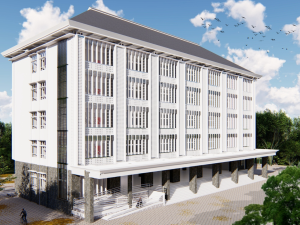
Source: Animal Science Learning Center (ASLC)
Additional policies are in place that oversee the renovation and construction of campus buildings which must adhere to energy efficiency standards, in accordance with Rector’s Regulation Number 157 Year 2020 and the Universitas Gadjah Mada’s Strategic Plan 2022-2027.
Policies on Saving Electricity Usage
Part of green behaviour is reducing electricity consumption. It is clearly stated in Rector’s Regulation Number 2 Year 2022 Management and Saving on Electricity Usage at UGM Article 15 that the electricity consumption in UGM must be reduced by 20% compared to the average usage over the six months preceding the enactment of this regulation. Saving electricity usage is carried out through: a. air conditioning system; b. lighting system; and c. supporting equipment (Article 16-18).
This regulation builds upon Regulation Number 157 Year 2020.
Article 16 of the regulation provides guidelines for implementing electricity savings by optimising air conditioning systems, lighting systems, and supporting equipment.
Article 17 demands green behaviour not only in the learning and teaching facilities, but also in the university office buildings. This includes turning off the air conditioning (AC) when the room is not in use and adjusting the room temperature in accordance with Indonesian National Standards (SNI), which range between 24°C and 27°C.
Regarding the Requirement for Electrical Systems (pg. 33), all faculties and university buildings must prioritize using energy-efficient appliances based on the Indonesian National Standard (SNI).
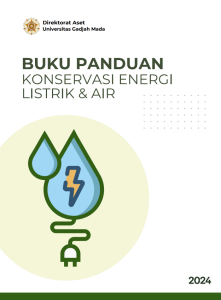
UGM also has a water and energy conservation guidebook which follows the international UI GreenMetric Guidelines. The technical guidelines serve as the performance indicator for the use of electricity and water in all buildings.
Water Management on Campus
The Rector Decree on Technical Guidelines for UGM Building Code is the basis of the Clean Water Management System on campus.
This system includes wastewater management on campus. Article 11 Verse 3 states that wastewater and foul water disposal systems must be carefully planned and installed based on the type and level of hazard. Wastewater management should comply with SNI and other relevant regulations, and treatment can be done either on-site or through an existing wastewater treatment plant.
Other articles of note are listed below:
Article 13 Verse 2 states the technical planning stage of campus green buildings require site management, energy use efficiency, water use efficiency, indoor air quality, use of environmentally friendly materials, waste management, and wastewater management.
Article 13 Verse 2 Section 3 concerning Water Use Efficiency addresses water source, water usage, and use of water-saving sanitary appliances (water fixtures).
Article 13 Verse 2 Section 7 concerning Wastewater Management addresses: a) providing facilities for the treatment of solid and liquid waste before disposal into the city sewer system and, b) recycling water from liquid waste (grey water).
Rector’s Decree Number 157/UN1.P/KPT/HUKOR/2020 adds to UGM’s water management by regulating the Rainwater Management System in Article 11.4. Every building and its surrounding area must have a rainwater management system to support environmental sustainability and water resource conservation. The total area for water absorption on the UGM campus, excluding forest and planted vegetation, is 1,071,734.26 m. This area consists of soil, grass, stormwater retention areas (including bio-pore and absorption wells), and conblock surfaces such as streets and parking areas.
Sources:
-
- Board of Trustees Regulation Number 1 Year 2021
- Circular Letter Regarding the Implementation of SDGs at UGM
- Circular Letter Number 16839/UN1.P/HK.02/2024
- Circular Letter Number 1797/UN1.P/KJM_BU/2020
- Circular Letter Number 9034/UN1.P/OT.01.03/2024
- Circular Letter Number 6627/UN1.P4/PL.00.00/2024
- Circular Letter Number 8846/UN1.P.V/Dit-Aset/TR.01.02/2023
- Standard Operating Procedure on waste disposal management
- Rector’s Decree Number 911 Year 2018
- Animal Science Learning Center (ASLC)
- Strategic Plan 2022-2027
- Rector’s Regulation Number 157 Year 2020
- Rector’s Regulation Number 2 Year 2022
- Water and energy conservation guidebook
- Rector Decree on Technical Guidelines for UGM Building Code