

Conservation of Karst Land
The Graduate School’s Environmental Science Program, together with the Karst Study Group of the Faculty of Geography, proudly hosted the 5th Asian Trans-Disciplinary Karst Conference 2024. The conference contained 3 main activities: field observation and data collection, summer courses, and seminars for disseminating activity results.
Participants embarked on a Joint International Cave Exploration in the Sangkulirang-Mangkalihat Karst Area of East Kalimantan and the Batu Benau Karst Area of North Kalimantan. The Karst Study Group collaborated with a team from China to collect data and map the caves in the two karst areas.
At the same time, a Summer Course entitled “Sharing with Experts on Cave and Karst Sustainable Management” was also held online. This summer course was attended by more than 40 participants from various countries and presented 18 lecturers and karst experts from various parts of the world.
The conservation and management efforts for the karst area concluded with a scientific conference attended by six symposia with 35 presenters and eight keynote speakers from 17 countries (Austria, Belgium, Brazil, China, Croatia, Italy, Japan, Laos, Myanmar, Malaysia, the Philippines, Vietnam, Senegal, Slovenia, Spain, the United States, and the United Kingdom).
Sustainable Use of Forests
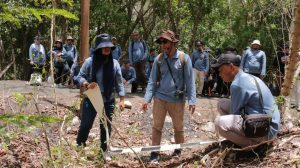
Source: Sustainable Land Restoration (SLR) training on critical land
FOLU refers to the forestry and other land use sectors. Indonesia has set a FOLU Net Sink 3030 target for carbon absorption to be greater than or equal to the emission produced by this sector. The program is regulated by the Decree of the Minister of Environment and Forestry Number SK.168/MENLHK/PKTL/PLA.1/2/2022 concerning Indonesia’s Forestry and Other Land Use (FOLU) Net Sink 2030.
In order to support the government’s carbon absorption targets, the Faculty of Geography became an implementing partner in the Sustainable Land Restoration (SLR) training on critical land in Indonesia which stems from a collaboration with the Indonesian Ministry of Environment and Forestry. The training’s focus area was determined based on the priority work areas of Indonesia’s FOLU Net Sink 2030 program.
Promote Sustainable Use of Land to Indonesian Youth
The SDGs Seminar Series #105 held by the Faculty of Geography took on the topic of “Implementation of Land Degradation Control Education at the Junior High School Level”. This year’s seminar discussed various efforts to control land degradation through environmental awareness from an early age. Collective awareness and understanding the process of land degradation at the junior high school level is crucial.
A practical implementation of land degradation control has been carried out at SMP Negeri 5 Yogyakarta as part of the Pancasila Student Profile Strengthening Project (P5) to foster environmentally conscious character. The school also has a Zero Trash Community (ZTC) Team where students are encouraged to sort and recycle waste, which is then managed by the ZTC team. The school also carries out environmental awareness campaigns through posters, videos, and social media activities to strengthen students’ understanding of environmental conservation.
References: