
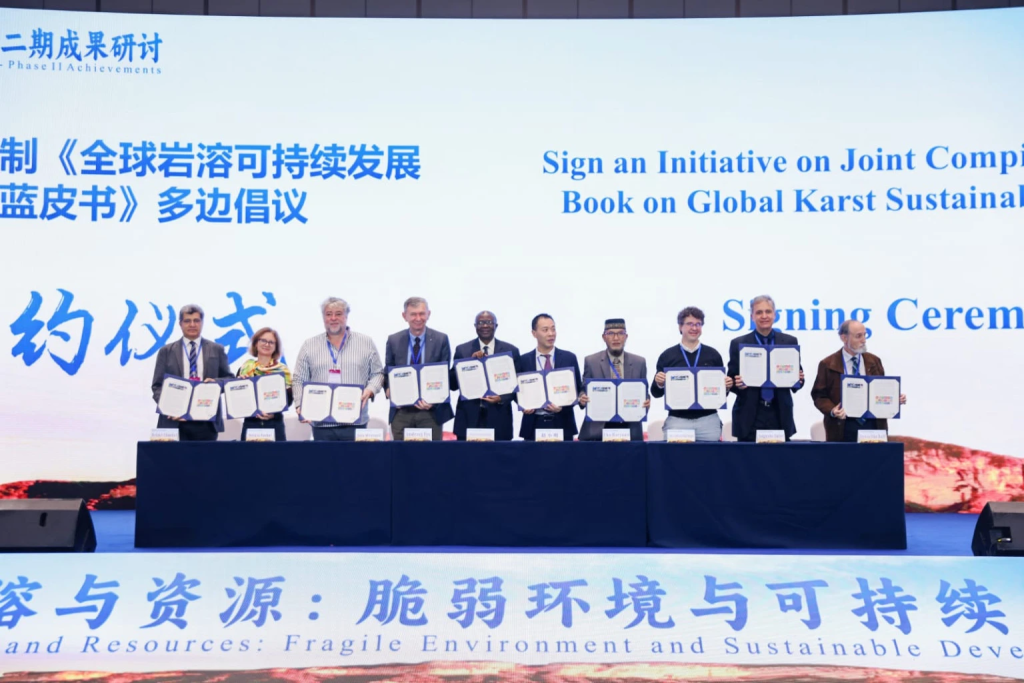
UGM actively participates in international collaborations to collect and measure data for the SDGs. UGM joined UNESCO’s global karst monitoring network through the International Research Centre on Karst (IRCK). Prof. Eko Haryono of the Faculty of Geography was appointed to the IRCK Governing Board for 2025–2031. He co-leads an IRCK project funded by China’s Ministry of Science. Through this project, Indonesia has installed spring monitoring stations at two sites, Gunung Sewu Geopark and a candidate geopark in North Kalimantan, as part of a global monitoring system. The network also covers karst areas in ASEAN, Europe and the United States, and in ASEAN only Indonesia and Thailand currently have stations. His role also includes environmental monitoring of UNESCO sites in Indonesian karst areas, including Gunung Sewu, Maros-Pangkep, Raja Ampat and Kebumen. The data from these stations supports sustainable management of karst water resources and ecosystems (SDG 6 and 15).

The appointment also reflects growing recognition of Indonesia’s role in shaping global policy on the protection and management of karst areas, and UGM is regarded as having Southeast Asia’s most consistent karst research group.
In January 2025, UGM participated in an international peatland field study. The Unconventional Geo-resources Research Group, led by Prof. Ferian Anggara, carried out fieldwork in Sebangau National Park, Central Kalimantan, with researchers from several countries. The study looked at how peatlands vary, focusing on peat characteristics and on peat as a model for how coal forms in the tropics. The partner institutions were China University of Mining and Technology, the University of Johannesburg (South Africa), the University of Queensland, Queensland University of Technology, RWTH Aachen (Germany) and the National University of Singapore. The field data adds to scientific knowledge of tropical peatlands, which are important carbon stores for climate action (SDG 13).

In collaboration with German researchers, the Faculty of Biology identified seven new species of Cherax freshwater crayfish from West Papua. The findings were published openly on 6 June 2025. These species were found in remote areas including Misool, Kaimana, Fakfak and Teluk Bintuni. The researchers analysed mitochondrial DNA to confirm each species, and they stressed the need for more research and distribution mapping to guide science-based conservation policy (SDG 15). The discovery of these species strengthens Indonesia’s national biodiversity database.
References