
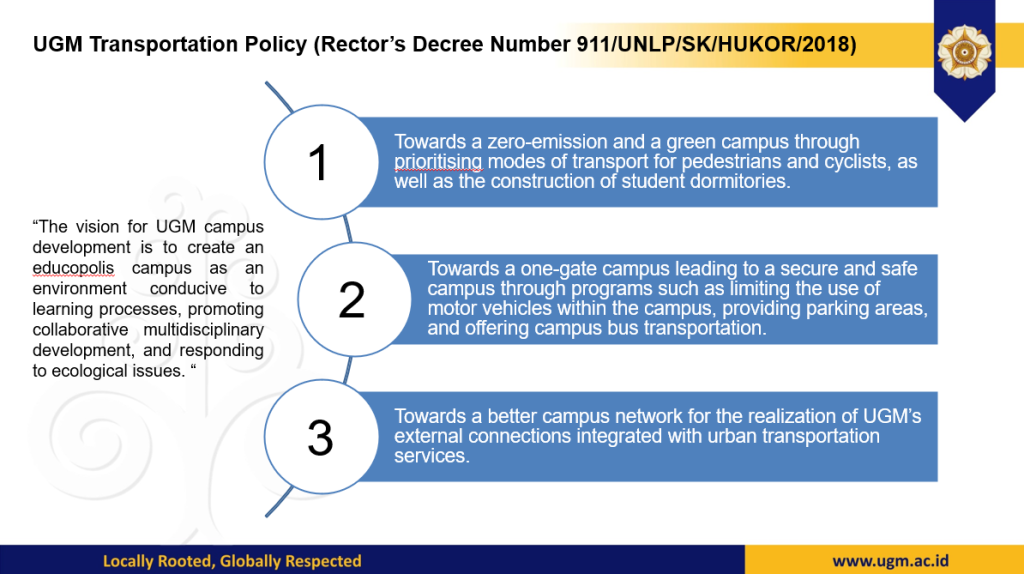
UGM has measured and set clear targets for more sustainable commuting. The Rector’s Decree Number 911/UNLP/SK/HUKOR/2018 provides the overarching transportation guidelines aimed at reducing carbon emissions and promoting sustainable commuting on campus. To operationalize this vision, the university implements two major programs with measurable targets.
Target 1: Decrease the number of Private Vehicles on Campus
This is carried out through several steps.
Step 1. Monitoring vehicle flow, by recording the number of vehicles entering and exiting campus through digital portal systems;
Step 2. Decreasing parking areas by implementing a centralized parking system that discourages driving directly into academic zones
Step 3. Enforcing parking restrictions and regulations to further limit unnecessary campus traffic
Target 2: Increase Sustainable Commuting
Improving access to low-carbon alternatives on campus that includes:
Step 1. Providing free and green transportation options, such as the Trans Gadjah Mada electric bus, campus bicycles facilities, and electric shuttles and motorcycles for employees
Step 2. Enhancing the pedestrian pathway network to ensure safe, connected, and comfortable walking routes across campus.
Target 1: Decrease the number of Private Vehicles on Campus
Step 1. Monitoring vehicle flow
In 2024, UGM recorded a low vehicle-to-population ratio of just 0.16, a figure the university has successfully maintained for three consecutive years since 2022. On average, 309,581 motorcycles and 52,986 cars entered the campus each month. These numbers reflect UGM’s ongoing commitment to closely track campus mobility, using the data to shape policies that limit private vehicle presence. To support this effort, the university continuously monitors the daily inflow and outflow of both cars and motorcycles at its campus gates.

UGM has a Main Gate located along the Boulevard/Pancasila Road and five Supporting Gates to improve the efficiency of vehicle tracking across campus. All private vehicles are routed through these designated gates, each equipped with automated portals and sensors that record daily inflows and outflows, and then guided towards controlled parking areas with fixed quotas.
Step 2. Decreasing parking areas
In 2023, UGM made a significant push toward greener mobility by cutting 4,766.02 m² of parking space—an impressive 10.75% reduction from the previous year. Many of these former parking zones have since been transformed into green areas and rainwater infiltration zones, turning once-paved surfaces into ecological assets. By 2024, the university maintained a total parking area of 39,559.99 m², reaching the lower threshold of what can reasonably be reduced—its ground parking now accounts for just 0.17% of the entire campus area, well below the 1% benchmark. Even so, UGM is not stopping there. The university has begun exploring ways to convert additional parking spaces into green open spaces and water absorption areas.

In 2024, UGM strengthened its sustainable mobility efforts through a centralized parking system. All 66,253 students are required to park in either their faculty’s designated area or one of nine centralized parking zones positioned around the campus perimeter—including KPTU, the Main Library, Olahraga Road, Agro Road, BTI, the north side of the Campus Mosque, the MIC basement, and the Pancasila Field area. Each site has separate motorcycle and car sections, with capacities ranging from 400 to 2,000 vehicles.
By placing these parking zones around the edges of campus, UGM significantly limits private vehicle movement within academic and administrative areas. This design reduces carbon emissions, improves air quality, and creates a more walkable, pedestrian-friendly environment.
Step 3. Enforcing parking restrictions and regulations
To further limit unnecessary campus traffic, he university has also issued regulations on vehicle parking within faculty and certain administration office premises. For example, private vehicles belonging to lecturers, students, and other staff members are not allowed to enter the Central Office area, except for special events. The Faculty of Agricultural Technology has released a policy stating: The parking areas within the Faculty of Agricultural Technology (FTP) are designated exclusively for FTP students, staff, and faculty. In the Faculty of Engineering, students bringing four-wheeled vehicles are only permitted to park in the parking area in front of the Faculty of Engineering, south of the Engineering Monument.
Target 2: Increase Sustainable Commuting
To move around campus, students, staff, and faculty can rely on several zero-emission transport options that are available to use free of charge.
Step 1. Providing free and green transportation options
The Trans Gadjah Mada electric bus system serves as UGM’s key eco-friendly transportation service, designed to provide efficient, accessible, and reliable mobility for everyone within the campus area. Bus stops are conveniently located near all faculties and main campus buildings with a passenger waiting time of 20 minutes.

UGM has enhanced the accessibility and ease of using the electric buses and campus bicycles through ICT innovation. In 2024, UGM launched the SIMASTER vNEXT application. This integrated platform not only allows users to manage and access information for all campus facilities, including the campus bicycles and electric bus, but also handles administrative tasks such as class schedules and attendance in one place.

Besides the bus, UGM offers a free campus bicycle facility. There are 11 designated bicycle stations across campus where students, staff, and faculty can register to borrow a bike to commute across campus. These locations can be accessed through the SIMASTER vNEXT app. The locations are strategically located near faculty buildings and key facilities such as the Library, the Sports Field (GOR Pancasila), and Wisdom Park.

The university has designed an integrated safe-cycling bicycle network. Through the app, one can locate bicycle paths, distinguishing between general bicycle lanes on public roads (blue) and bicycle paths inside the campus area (green). The bicycle paths pass through all 20 faculties and schools and administration buildings. Several roads are for bicycles only, cars and motorcycles are not allowed to enter. The stations for parking and renting campus bicycles are also found in parking lots, so students who bring motorized vehicles to school can immediately switch to green transportation inside the campus.


For employees, UGM provides 8 electric car shuttles and 52 units of electric motorcycles to commute across campus. They serve as an eco-friendly commuting option for staff during lunch breaks or when attending meetings at faculties and other campus buildings. The car shuttles are also available to university guests and persons with disabilities.
Step 2. Enhancing the pedestrian pathway network
The pedestrian pathways in UGM are designated walkways designed for UGM students, staff, and any person walking through campus to travel on foot. Anyone passing through campus can use these pathways to travel from one building to other buildings, as well as to campus vehicle parking areas, the Trans Gadjah Mada electric bus stops, and bicycle stations. In order to ensure a safe, accessible, and inclusive pedestrian environment these pathways are equipped with features such as canopies, lighting, ramps and guiding blocks designed to assist persons with special needs, benches, crosswalks, and separators between pedestrians, bicycle lanes, and the motorcycle/car lanes. In addition, there are several signs posted along the main campus roads instructing vehicle drivers to prioritize pedestrians, mind crossings, and prohibit vehicles from using the pedestrian pathways.

References:
- Rector’s Decree Number 911/UNLP/SK/HUKOR/2018
- UGM UI GreenMetric Data 2024