
UGM is a microcosm of Indonesia, with members of its academic community representing all 38 provinces. The university itself is located within the Special Region of Yogyakarta, home to the Yogyakarta Sultanate, one of the last remaining royal courts in Southeast Asia. Since the Sultan’s Palace first stood in 1755 to this day, the city holds political and cultural influence. The city is rich with Javanese culture and local arts that include silversmiths, handcrafted batik, gamelan orchestras, Javanese dance, folk performances, children’s traditional games, and divine culinary cuisines such as gudeg and bakpia.
UGM hosts arts and heritage performances year round. Annual events include:
The Gelanggang Expo (GeLex UGM), which is held at the start of each academic year, typically around August. It features performances and information booths, facilitating student involvement in arts, sports, and special interest groups. In 2022, GeLex featured a collaborative stage performance by Student Activity Units, adapting the Ramayana wayang story with a blend of classical and contemporary arts. The performance involved 100 performers and was attended by 15,000 students. That year, GeLex also encouraged visitors to wear traditional fabrics to promote traditional attire.
The Faculty of Philosophy also conducts annual performances to promote Karawitan, a Javanese musical tradition using Gamelan. In the year 2024, a Temanggung Karawitan Festival was organised in collaboration with the Temanggung Regency’s Department of Culture and Tourism. This festival aims to preserve and promote karawitan in the community.
The university has a Faculty of Cultural Sciences whose 26 student organizations (or BSOs) function as a community for students to develop their talents, interests, and skills. Students can join activities, express creativity, gain experience, and contribute to cultural arts and heritage through various programs, performances, and educational events held both within and outside UGM. Several of these BSOs also participate in competitions at national and international levels.
- Teater Terjal: Teater Terjal is a space for students who love drama—whether watching, acting, or creating it. This BSO gathers creative souls who believe that the stage can be both a pulpit and an arena. They often perform Pentas Keliling (touring performances), including shows at Taman Budaya Yogyakarta.
- Sastra Oebah: A BSO that focuses on dance arts. They explore traditional and modern dance—ranging from classical Indonesian dance, modern choreography, to contemporary creative works.
- Bejomulyo: Bejomulyo is a BSO centered on photography, based on the philosophy that every photograph is a unique artwork. Bejomulyo provides a space to learn, collaborate, and showcase visual stories through and beyond the camera lens.
- Sastra Kinematika: Saskine is the perfect BSO for students who love movies and filmmaking. Here, students can explore various film-related roles such as cinematographer, scriptwriter, costume designer, or even director. Saskine also welcomes those who enjoy analyzing or reviewing films and theatrical works.
- Paramadaya: An organization for students to sharpen their singing talent. This BSO actively participates in numerous music and performance activities both within and beyond FIB. Their signature annual program is the Paramadaya concert, held at the end of each year.
- Sanggar Lincak: The Sanggar Lincak is a creative space for students who love writing or performing poetry. They host a monthly poetry-sharing event called Rabu(n) Senja, and their yearly flagship program is the publication of a collaborative anthology written by all members.
- Sastra Budaya: A student organization focused on entertainment-based arts, including event production, music performance, and traditional kethoprak comedy.
- Dian Budaya: A BSO that produces zines and magazines featuring writing and illustrations, providing a platform for students interested in popular writing and visual expression.
- Rampoe UGM: An open community dedicated to Acehnese traditional dance, involving students from UGM and beyond in cultural performance activities.
A vibrant ecosystem of student-led organizations also plays a key role in advancing arts and heritage on campus, including:
The Swagayugama student organization is engaged in preserving Javanese arts of the Yogyakarta style, particularly in the fields of dance, karawitan (traditional music), and puppetry. Their performances are listed here.
The Surakarta-Style Javanese Arts Unit (UKJGS) is one of the student organizations that focuses on training in traditional Javanese arts of the Surakarta style, including dance, karawitan (traditional music), and puppetry. Although Surakarta style is the main focus, the unit also studies other regional styles such as Banyumasan, Semarangan, Sundanese, Balinese, and more.
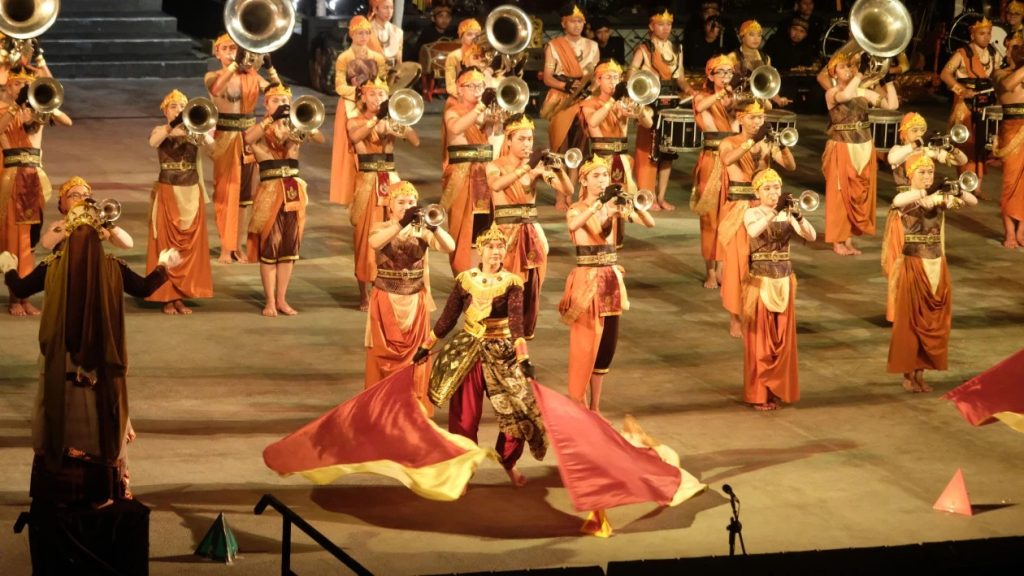
There is also the Gadjah Mada Chamber Orchestra (GMCO) and the UGM Marching Band.

Source: Pangupajiwa: Marta Sang Mahapatih Gajah Mada
The UGM Marching Band held a grand performance at the Ramayana Ballet Prambanan titled “Pangupajiwa: Marta Sang Mahapatih Gajah Mada,” to celebrate its 45th anniversary since its establishment in 1979. For the performance, they collaborated with Gutami Hayu Pangastuti from SMA Negeri 2 Yogyakarta Theater, SMA Negeri 3 Yogyakarta Theater, students from the Indonesian Institute of the Arts (ISI) Yogyakarta, and the Surakarta-Style Javanese Arts Unit (UKJGS) UGM. The Pangupajiwa performance tells the life story of Patih Gajah Mada, the legendary figure known for the Palapa Oath. His efforts to unify the archipelago are interpreted as the foundation of Indonesian civilization.
Adding to this vibrant environment, lecturers, staff, and their families have also formed their own arts groups, such as:
Kelompok Angklung Fapet

The Faculty of Animal Science Angklung Ensemble, established in 2022, is a 36-member community comprising undergraduate and graduate students, Professional Engineer students, lecturers, academic staff, and retirees. Formed to nurture interest in Indonesia’s traditional musical heritage, ASAC promotes angklung—recognized by UNESCO as a Masterpiece of Human Oral and Intangible Cultural Heritage—as a signature cultural instrument of the Faculty. The group rehearses weekly and regularly performs at faculty and university events, including graduation ceremonies, new student receptions, professor inaugurations, reunions, culture nights, and artistic showcases. ASAC has also represented the faculty in competitions, earning second place at the Fabbuland Kids and Parents Festival in September 2023.
The Manise Swara UGM Angklung Ensemble
The Manise Swara UGM Angklung Ensemble is a 22-member musical group formed by the Dharma Wanita Persatuan of FEB UGM. They recently enlivened the 69th FEB UGM Family Fun Evening with harmonious angklung performances of popular Indonesian songs such as Tanah Airku, Prau Layar, Yogyakarta, and Selamat Ulang Tahun.
References: