
As Indonesia’s oldest public university, UGM carries a legacy woven into the nation’s own history, not only witnessing Indonesia’s journey to independence, but also shaping generations of alumni who have played defining roles.
UGM Museum
First we have the UGM Museum, located in the former official residences Bulaksumur D6 and D7 inside the Main Campus area. The museum is free to access and open to the public. Opening hours are on Monday to Friday from 9 a.m. to 4 p.m. To reach the museum, visitors can easily enter through UGM’s Main Entrance gate, continue along Pancasila Road, and turn right into the Bulaksumur building complex.

The UGM Museum is a relatively young museum, first inaugurated on 19 December 2013. Despite its age, it holds rich historical value, including a room where the young former US President Barack Obama stayed during his childhood visits to Yogyakarta. The museum showcases UGM’s historical artifacts, photographs, founding figures, achievements, and academic contributions, and it has attracted visitors from Indonesia and abroad. It is envisioned as a space that reflects UGM’s identity as a university of struggle, nationalism, culture, and Pancasila.
The museum has permanent exhibitions are classified into six different eras, which are:
- In the Midst of Struggle (1946-1949): This gallery delves into UGM’s establishment during Indonesia’s fight for independence, highlighting the university’s foundational role in the nation’s early years.
- Laying the Educational Foundation (1949-1960): Focusing on UGM’s formative years, this section showcases efforts to build a robust educational framework and the university’s initial achievements.
- Building the Nation’s Civilization (1961-1982): This exhibit illustrates UGM’s expansion and its significant impact on Indonesia’s cultural and intellectual development during this period.
- Becoming a World-Class University (1982-2002): Highlighting UGM’s strides towards global recognition, this gallery presents milestones that elevated the university’s international standing.
- Upholding the Nation’s Dignity (2002-2017): This section reflects UGM’s ongoing commitment to national pride and its role in addressing contemporary challenges.
- Life in Bulaksumur: Offering a glimpse into campus life, this exhibit portrays the daily experiences and traditions within the UGM community.
In addition to these permanent exhibits, the museum often arranges temporary exhibitions that focus on specific themes or notable figures. For instance, the museum featured the “Karsa Karya Koesnadi Hardjasoemantri” exhibition celebrating the contributions of a distinguished UGM alumnus.
The UGM Biology Museum
Another museum located inside the Main Campus area is the UGM Biology Museum managed by the Faculty of Biology. The museum originated from the merger of the Zoological Museum and the Herbarium Museum. It first opened to the public on January 1, 1970, and features dioramas and exhibits of various classified animal and plant specimens, serving as a scientific resource for Yogyakarta and the surrounding region. It functions as an educational facility for students, researchers, and the general public, offering insights into Indonesia’s rich biodiversity.
The Biology Museum remains open to the public with ticket prices for students/university students at Rp 7,000; for the general public at Rp 10,000; while foreign tourists at Rp 15,000. Most visitors are school students, and the busiest period is at the start of the academic semester.
The museum provides public services such as educational tours, workshops, and seminars that promote the biological sciences. One of its most captivating exhibits is the extensive collection of taxidermy specimens, which provides a unique opportunity to study and appreciate the nation’s wildlife.
The UGM Museum of Biopaleoanthropology and Anatomy
UGM’s Museum of Biopaleoanthropology and Anatomy brings ancient history to life through a modern, interactive experience. Located in the Faculty of Medicine, Public Health, and Nursing, the public museum blends digital touch-screen displays with captivating fossil collections—from a million-year-old Pithecanthropus erectus skull fragment to prehistoric elephant tusks found in Sangiran. Revitalized with immersive exhibits and striking outdoor sculptures, the museum offers public access and visitors—especially young learners—experience a fun and dynamic way to explore human evolution, primate anatomy, and the intricate structures of the human body.
The Wanagama Museum

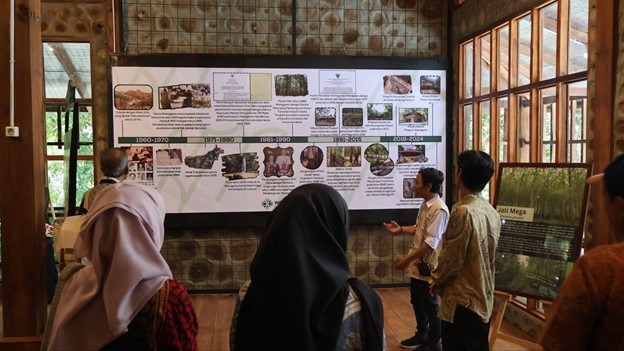
The Wanagama Museum offers a fresh and lively gateway into Indonesia’s rich world of forestry and wood biodiversity. Located within the Wanagama Eco-Edu Forest area in Gunung Kidul Regency (approximately 35 km from Yogyakarta’s city center), the museum showcases three-dimensional specimens of wood from across the archipelago— including rare, endemic, and fossilized pieces millions of years old—alongside exhibits on how wood shapes everyday life. Its second floor hosts rotating thematic displays, currently featuring films shot in Wanagama. The museum was inaugurated in 2025 through a major grant from the Ministry of Environment and Forestry. It is now open to the public and blends education, conservation, and community engagement, inviting visitors of all ages to explore the history, culture, and future of sustainable forest stewardship.

Source: Activities at Wanagama Museum
Previously, Wanagama housed the Wanagama Wood Museum which was inaugurated in 1998 and listed in the Cultural Service of the Special Region of Yogyakarta Province. The museum’s building itself represented a heritage site; constructed from two traditional wooden houses dating back to 1880 and reassembled into a single elevated structure. Currently, the building is under renovation and the exhibitions have been merged into the new museum.
The PIAT Orchid Garden
Though not exactly a conventional museum, the Orchid Garden at PIAT resembles more of a living museum—similar to the one in Wanagama Forest. It offers a vibrant experience, showcasing an impressive collection of orchid species used for education, research, and community collaboration. Members of the public can visit the garden which is located in Berbah, Sleman Regency.

Each year, the garden hosts the Orchid Festival, where hundreds of orchids from PIAT’s own collection and local enthusiast communities are displayed alongside activities such as auctions, talks, and children’s workshops. Recently reopened with renewed focus, the garden also launches programs like Nganggrek nang Kampus to promote orchid cultivation, mindfulness, and innovation. As a growing hub for training, discussion, and public engagement, the PIAT Orchid Garden connects science, community, and the beauty of Indonesia’s rich orchid biodiversity.
References: