
UGM provides assistance for start-ups that foster and support a low-carbon economy or technology.
Local assistance programs
Through Student Sociopreneur Programs, UGM actively encourages student entrepreneurship in environmental solutions. Examples of supported student-led startups include:
Stivalution: A business creating eco-friendly bio-pellet fuel from plastic waste and rice husks.
Kronikologi: An innovative solution for processing organic waste using Black Soldier Fly (BSF) larvae to create valuable products.
PLUMIX: A business utilizing chicken feather waste to create eco-friendly organic fertilizer.
Regional assistance programs
UGM supports BANANA & Partners, a company engaged in consultancy, recycling, and trading with a primary focus on waste management and sustainability projects. The company is currently engaged in a reforestation project on post-mining land in East Kalimantan, covering more than 200 hectares. They oversee all aspects from planning to calculating carbon and biodiversity impacts.
National assistance programs
A student team from the Faculty of Economics and Business created an eco-friendly cement called “Innocem”. The product was made out of processed seashell waste, unlike conventional cement which is made from limestone and as a result produces high carbon emissions. Through Innocem, its inventors aim to support the net zero emissions agenda. The product is currently being marketed online through marketplace platforms and Innocem’s official website.
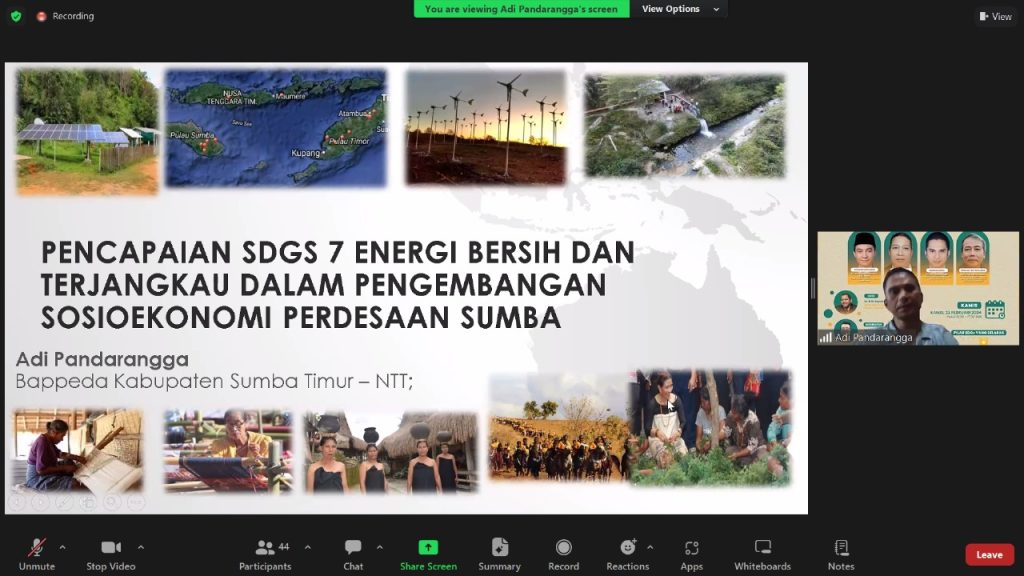
The Faculty of Geography held the 98th Sustainable Development Goals Seminar Series on “Achieving SDG 7: Affordable and Clean Energy in the Socioeconomic Development of Rural Sumba.”
Among the keynote speakers, Siti Suryani, M.S.Ak., S.E. shared her experience of developing a micro-hydro power plant in Kamalapia Village, East Sumba that generated 3,800 watts of electricity for the entire village. The power plant gave the community access to electricity, one of the key efforts to reduce vulnerability.
Speaker Dr. Adi Pandarangga shared the achievement of SDG 7—affordable and clean energy—in the socioeconomic development of rural Sumba. Sumba Island is being positioned as the Sumba Iconic Island, serving as an energy backbone for East Nusa Tenggara and surrounding areas through the utilization of new and renewable energy sources to meet economic activity needs and basic services.
Global assistance programs
UGM collaborates with PT. Gema Phala Ananta, a start-up dedicated to accelerating the transition toward more environmentally friendly green technologies. The company developed a Carbon Accounting and MRV (Measurement, Reporting, and Verification) platform that will provide data-driven insights and solutions to help industrial sectors reduce their carbon footprint. Through this platform, companies can monitor and improve their environmental impact more efficiently.
References: