
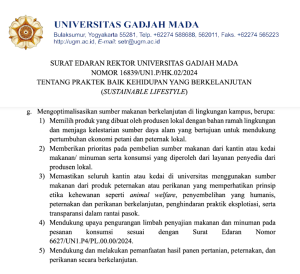
UGM is committed to divesting from carbon-intensive energy industries in order to promote sustainable lifestyle on campus. This is iterated in Circular Letter Number 16839/UN1.P/HK.02/2024 on Sustainable Lifestyle. Point 6 (b) states that UGM will implement policies that promote sustainability, which includes avoiding financial involvement with companies operating in industries with high carbon emissions (refer to pg. 4). The goal of divestment is to move away from industries that harm the environment and contribute to climate change.
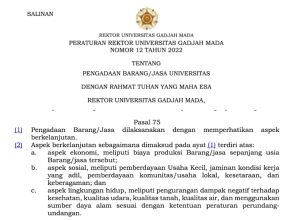
UGM’s commitment to divesting from industries with high carbon emissions is also reflected in the university’s procurement process of both goods and services that prioritize sustainability aspects. UGM chooses products made by local producers using environmentally friendly materials and preserving natural resources. By sourcing goods from local producers and businesses, such as food ingredients for the university canteens, UGM reduces the amount of carbon emissions produced from logistics and delivery. Refer to Rector Regulation Number 12 Year 2022 concerning Procurement of goods/services at the university, specifically Article 75.
Our university has taken measures to shift away from industries such as coal and oil by building an integrated and green campus transportation system. With the aim of promoting sustainable commuting, UGM is increasing the number of electric vehicle charging stations on campus. Our campus operates electric vehicle (EV) shuttles that were donated by partners upon UGM’s request for zero-emission vehicles (ZEVs).
The available EV shuttles include:
- The Trans Gadjah Mada electric bus, which serves as UGM’s key eco-friendly transportation service, designed to provide efficient, accessible, and reliable mobility for everyone within the campus area.
- The UGM Electric Car Shuttle Service, which serves as an eco-friendly option for staff and faculty, and persons with disabilities to commute across campus.
Our university also provides 52 units of electric motorcycles which can be used by staff during office hours.
Since 2024, two public EV charging stations have operated at the Faculty of Engineering and later this year, the university will begin development of two new EV charging stations (one 22kW Standard Charger and one 200 kW Fast Charger) placed near our multipurpose building, the Grha Sabha Pramana.
We have further committed to divest from carbon-intensive energy industries via programs to reduce energy consumption of campus buildings and developing buildings with higher energy efficiency, as well as the adoption of renewable energy sources. Our university has successfully run wind power, biogas, solar PV, and micro-hydro power plants and produced electricity capable of lighting buildings and infrastructure.
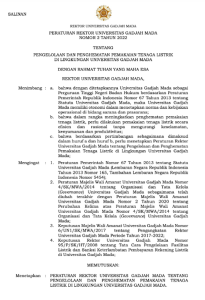
This is stipulated in Rector Regulation Number 2 Year 2022 concerning Management and conservation of electricity usage within Universitas Gadjah Mada.
References: