
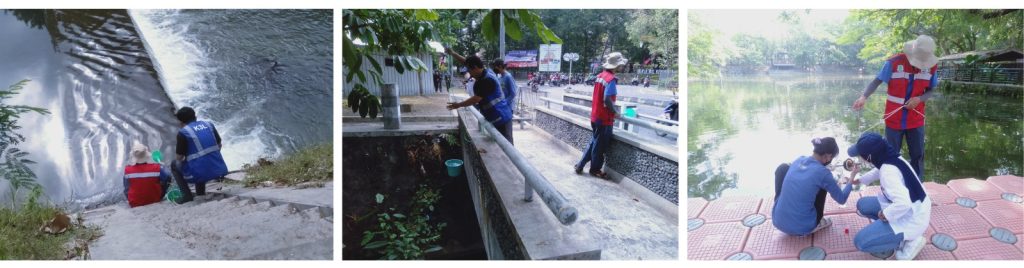
UGM has established policy and programs for water pollution control which are fully implemented and monitored regularly.
UGM’s policy is to monitor and test campus water quality through the Office of Security, Occupational Safety, Emergency, and Environmental Affairs (K5L) every six months. Monitoring activities are based on national and regional regulations:
- Government Regulation of the Republic of Indonesia Number 82 of 2001 Concerning Water Quality Management and Water Pollution Control
- Clean Water Quality Standard No. 416/Menkes/Per/IX/1990
- Government Regulation of the Republic of Indonesia No. 22 of 2021 concerning Environmental Maintenance and Management.
- Yogyakarta Provincial Regulation (Perda DIY) No. 7 of 2016 on Wastewater Quality Standards
All water quality parameters at UGM fulfil the criteria of both regulations. The full document for the regional regulation published by the Governor of the Special Region of Yogyakarta on sewage water treatment: Regional Regulation (PERDA) of the Special Region of Yogyakarta Province No. 2 of 2013
Wastewater Treatment
Universitas Gadjah Mada has a system to prevent polluted water from entering the water system by using wastewater management and a microfilter. Wastewater management at UGM is divided into two types: black water (wastewater from toilets, bidets, and urinals) and grey water (wastewater from kitchen sinks, washbasins, and floor drains). The Prof. Soedomo Dental Hospital WWTP and the Ratnaningsih Dormitory WWTP are already connected to the province’s Sewon WWTP network. Most faculty canteens are already equipped with pre-treatment installations (oil and grease traps) ,and the generated wastewater is discharged into the Biofil system.
Several faculties and units at Universitas Gadjah Mada have implemented greywater recycling programs, including the UGM Campus Mosque, Kinanthi Residence Dormitory, Faculty of Economics and Business, SGLC Building of the Faculty of Engineering, and the Faculty of Animal Science.
The Faculty of Animal Science has an adequate environmental management system supported by a Sewage Treatment Plant (STP) and a Water Treatment Plant (WTP). The STP functions to treat wastewater from laboratory activities, the canteen, and public facilities before it is discharged into the environment, ensuring that it is safe, meets quality standards, and is environmentally friendly. Meanwhile, the WTP provides clean water that meets health standards for practical classes, research activities, and public facilities within the faculty. The presence of both the STP and WTP demonstrates the Faculty of Animal Science’s commitment to environmental sustainability, the health of the academic community, and the implementation of green campus principles and environmentally friendly laboratories.
The SGLC Building of the Faculty of Engineering has also implemented wastewater treatment using approximately six Chemical Wastewater Treatment Plants, which are located in the yard and along the roads surrounding the SGLC to reduce pollutant levels in the wastewater produced.
The discharge of domestic wastewater to the Sewon WWTP is currently implemented in several buildings, namely Ratnaningsih Sendowo Dormitory, Ratnaningsih Kinanti 2 and 3 Dormitories, and the Mardiyah Islamic Center. At present, wastewater from bathrooms and toilets is generally treated using septic tanks or biofilters, with the effluent absorbed through onsite systems. Likewise, wastewater from campus canteens is currently treated through absorption systems.
Universitas Gadjah Mada has an Environmental Evaluation Document and has permission from the relevant government agency to monitor water conditions. Monitoring and evaluation reports are done regularly every 6 months. The university sends teams to conduct quality control of the groundwater on campus and in the surrounding areas. These teams are led by the Office of Security, Occupational Safety, Emergency, and Environmental Affairs (K5L). UGM monitors and tests the quality of water sources and bodies of water located inside and near the main campus area, such as the lake in UGM Valley, the shallow wells near faculty buildings, and the Belik and Code Rivers.
Sampling of bodies of water around UGM was taken from two points: Sungai Belik Hulu and Lembah Lake UGM and sent to the Health and Calibration Laboratory Center, Special Region of Yogyakarta Health Agency for testing. The Water Quality Test Reports issued tested parameters include pH, turbidity, total dissolved solids (TDS), total suspended solids (TSS), dissolved oxygen (DO), ammonia, phosphate, nitrate, COD, heavy metals (Fe, Cd, Cr, Pb, Mn), sulfide (H₂S), cyanide (CN), and BOD₅. The results provide evidence of UGM’s continuous efforts in monitoring and maintaining the quality of campus water bodies to ensure compliance with national environmental standards and to support sustainable campus management.
The documents presented are the Groundwater Quality Test Reports, issued by the Health and Calibration Laboratory Center, Special Region of Yogyakarta Health Agency. The tests were conducted according to the Minister of Health Regulation (Permenkes) No. 2 of 2023 concerning drinking water quality requirements.
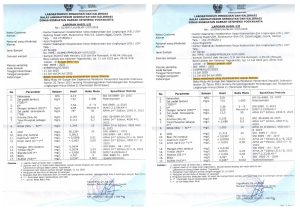
Meanwhile, the sampling points of various ground reservoirs and deep wells across campus were taken from Ground Reservoir Timur and Barat, Deepwell Pertanian, Deepwell Lembah, Deepwell Filsafat, Deepwell Peternakan, and others. Parameters analyzed covered physical, chemical, and biological indicators, including:
- Physical parameters: color, turbidity, temperature, and total dissolved solids (TDS).
- Chemical parameters: pH, chloride (Cl⁻), sulfate (SO₄²⁻), fluoride (F⁻), nitrite (NO₂⁻-N), nitrate (NO₃⁻-N), iron (Fe), chromium (Cr⁶⁺), and manganese (Mn).
- Biological parameters: Escherichia coli and total coliform bacteria.
The results serve as baseline data for evaluating UGM’s groundwater quality and ensuring that it remains within the national drinking water standards. Any detected exceedances of permissible limits become a reference for UGM’s follow-up actions in improving groundwater management and protecting environmental health across the university area.
The contribution of universities in preventing water system pollution in the community
The province of South Kalimantan, particularly the Barito Kuala region, faces a significant challenge with high water acidity levels. This issue stems from the presence of pyrite minerals within the area’s peatlands, which, upon oxidation, produce sulfuric acid. The resulting water pollution poses a considerable threat to human health, leading to adverse effects such as skin damage and allergic reactions.
In response to this environmental and public health issue, the UGM Community Service Program Team has implemented a water purification initiative. This program utilizes advanced filtration methods to provide local residents with access to clean water for their daily needs, thereby mitigating the health risks associated with the high acidity levels. This initiative underscores the university’s commitment to applying scientific expertise to solve pressing community challenges.