
UGM encourages women participation in subjects where they remain underrepresented, particularly in STEM, engineering, and other technical disciplines.
While the university does not publicly disclose detailed enrollment statistics by gender for each program, it is generally observed that certain fields tend to have lower female representation, which is similar to global trends. The underrepresented subjects in UGM, as shown in the figure below, include the Engineering and Technology Cluster, with disciplines such as Mechanical Engineering, Electrical Engineering, and Computer Science typically seeing fewer female students.
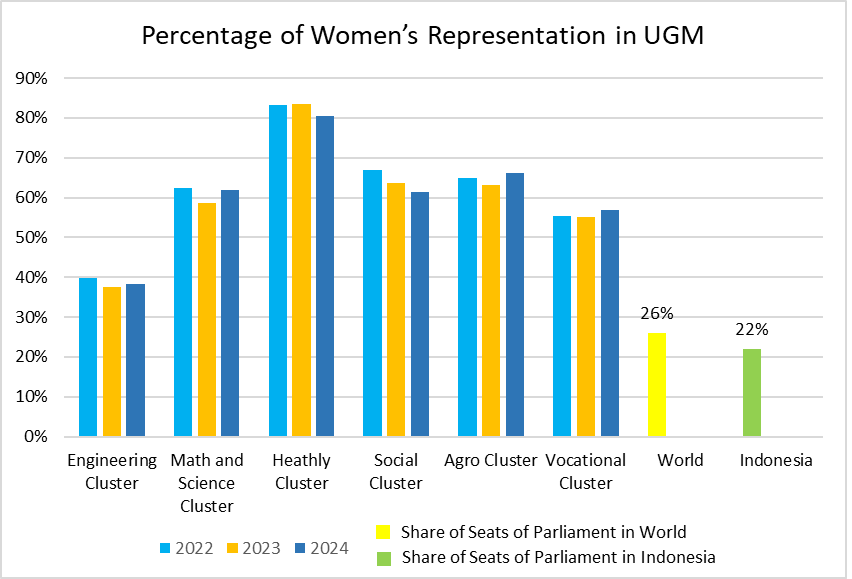
However, the proportion of female students in these underrepresented subjects at UGM is still higher than Indonesia’s minimum parliamentary quota for women (22%), which serves here as a comparative benchmark for identifying fields with low female representation. This suggests that although engineering and technology remain male-dominated, women’s participation at UGM has surpassed the commonly acknowledged threshold used in national policymaking.
To address these disparities, UGM has implemented various initiatives aimed at encouraging women’s participation in these subjects:

Source: Global Innovation & Future Technology Summit (GIFTS) 2024
The university provides mentorship programs and support networks to assist female students in navigating their academic and professional journeys within these disciplines. UGM hosted the Global Innovation & Future Technology Summit (GIFTS) 2024, a two-day international forum full of seminars, workshops, and hands-on training for women and was hosted by GIK UGM in collaboration with the National University of Singapore and Tsinghua University. The summit brought together leading academics, industry innovators, and policymakers to spotlight the critical role of women in Science, Technology, Engineering, Arts, and Management—fields where female participation remains at just 28%.
UGM’s Japan Career Center (JCC) at FMIPA also contributes to widening women’s access to underrepresented STEM fields by building international pathways through its collaboration with the ASEAN Nagoya Club in Japan. Although not gender-specific, the program strengthens outreach by preparing students—including women—to enter global industries in areas like IT, physics, mathematics, semiconductors, and artificial intelligence, which traditionally have lower female participation. Through mentorship, skills training, and direct links to more than 700 companies in Japan, JCC helps ensure that women gain equal access to high-demand technical careers and the international networks needed to thrive in STEM professions.
References: