
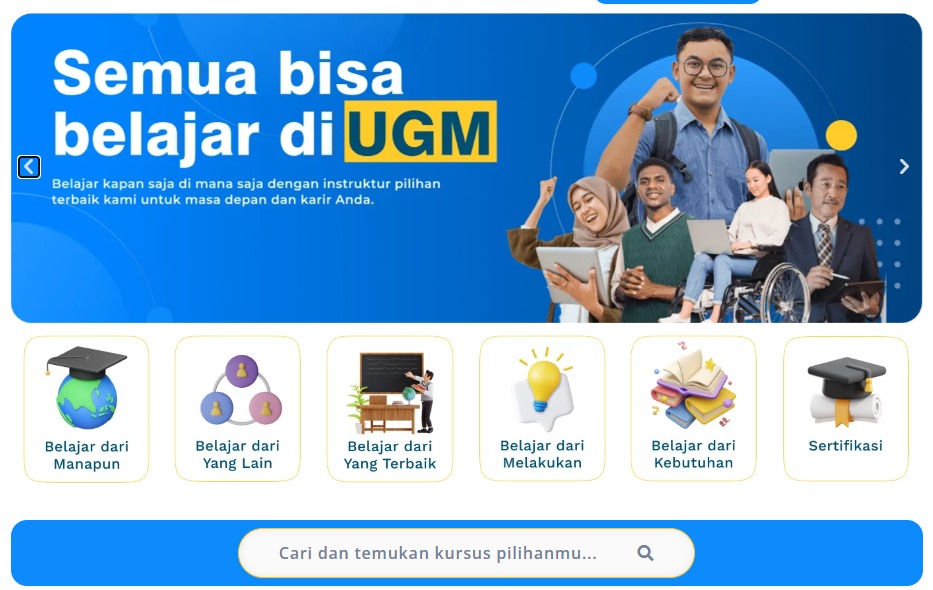
Free Access to Educational Resources at UGM: Courses, Facilities, and Training Programs
Free courses leading to certificate or award
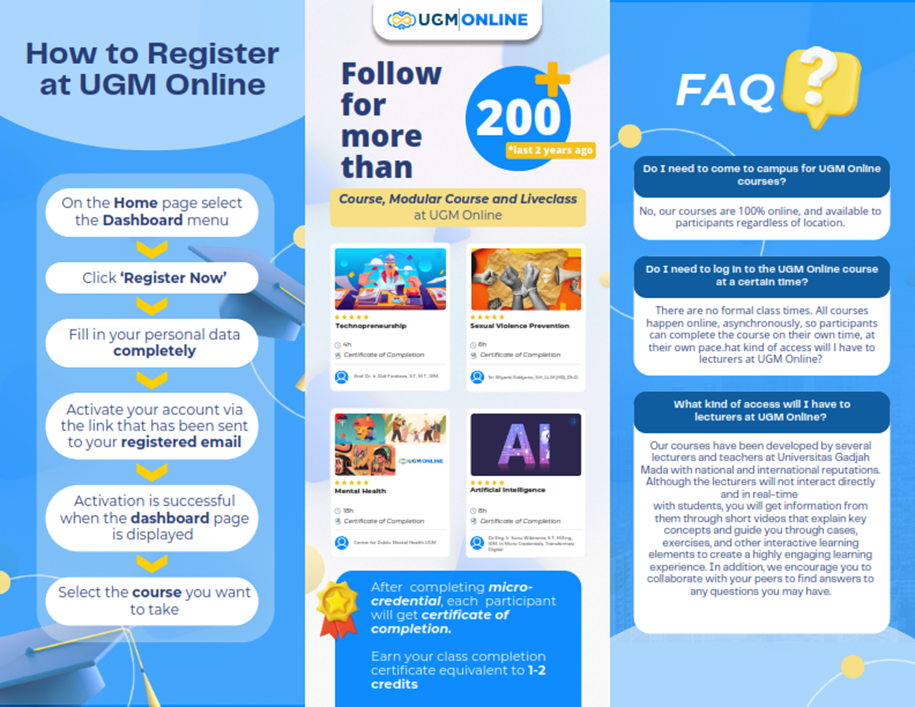
The university has supported the implementation of free courses through the Massive Open Online Program (MOOC). MOOC is a platform accessible to people who are not studying at the university. Many classes are divided into categories such as business, health, politics, digital transformation, etc. This implementation supported Universitas Gadjah Mada’s Strategic Plan 2022-2027 and the government rules in Permendikbud Ristek No.52 from 2023 about Quality Assurance in Higher Education.
In 2024, Universitas Gadjah Mada (UGM) enhanced the quality of its Massive Open Online Courses (MOOCs) and micro-credential programs through international collaboration. As a core member of the Southeast Asian University Consortium for Graduate Education in Agriculture and Natural Resources (University Consortium/UC) under the Southeast Asian Regional Center for Graduate Study and Research in Agriculture (SEARCA), UGM once again received ERASMUS+ funding. This initiative involves nine universities across Southeast Asia, SEARCA, and two partner universities in Europe. The program builds upon a previous ERASMUS+-funded collaboration (2016–2019) that successfully established a Joint Master of Science in Food Security and Climate Change, further strengthening academic partnerships and regional capacity in sustainable development education.
Sources: https://elok.ugm.ac.id/
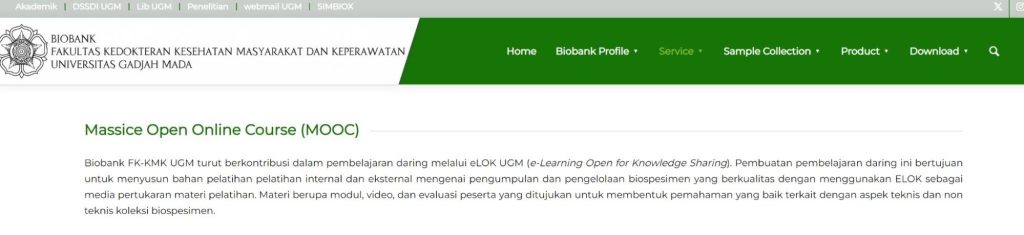
MOOC is implemented in eLOK (e-Learning Open for Knowledge Sharing) UGM. The university offers specific courses that can be taught by all students in Indonesia. Some faculty members, such as FK-KMK and FISIPOL, contribute to the online learning system. FK-KMK contributes to eLOK by arranging internal and external learning about the quality of Biospecimen through modules and videos.
Sources: Website FK-KMK
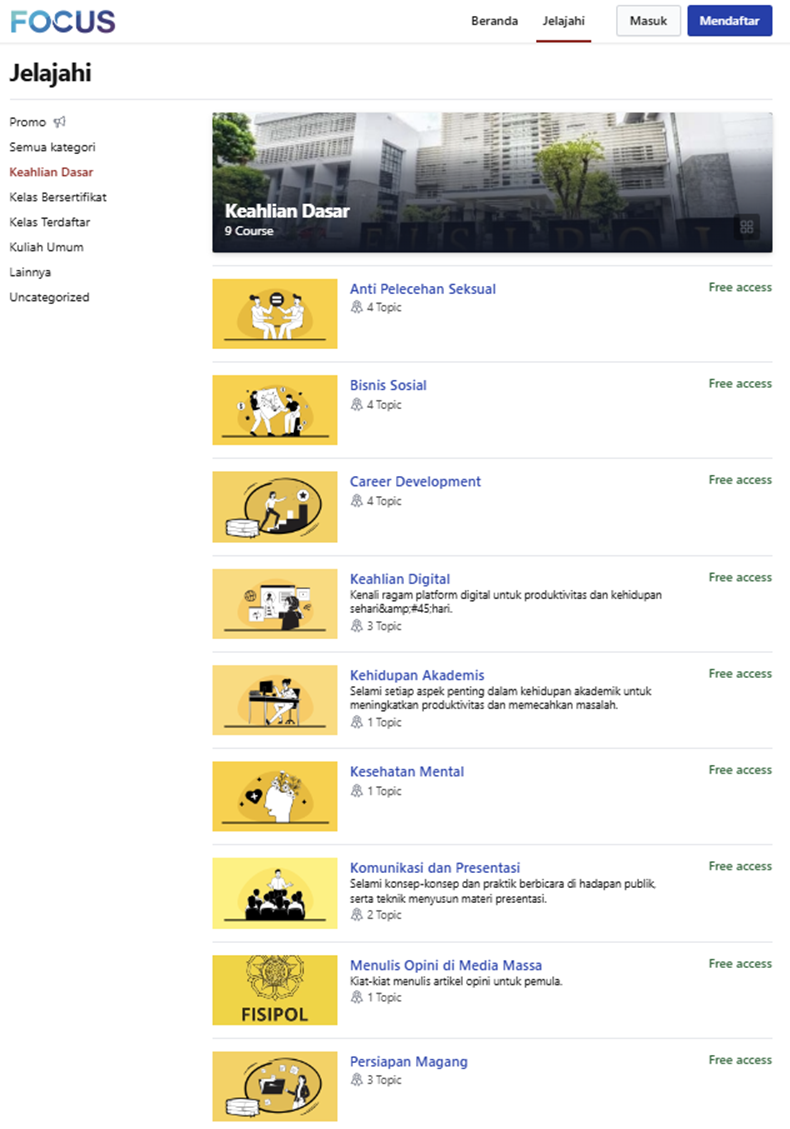
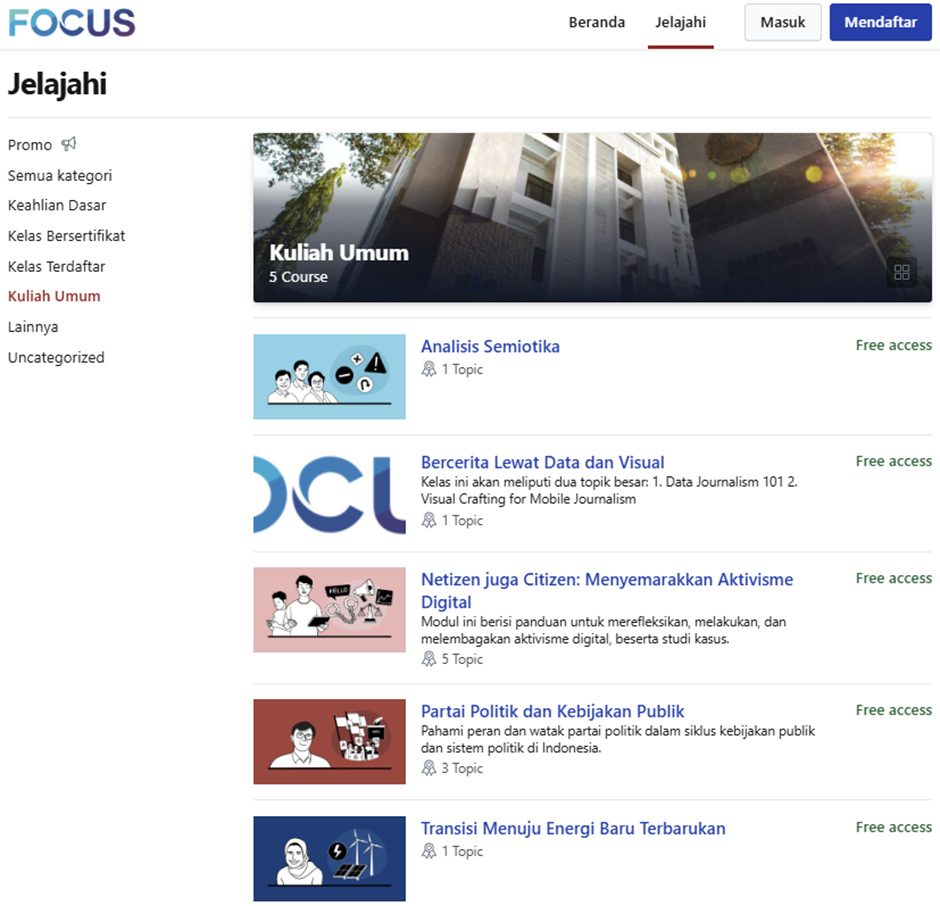
FISIPOL UGM built their own facilities to support free access to educational resources. The Digital Intelligence Class is accessible in public with Artificial Intelligence (AI) as the main focus. It also supported the government’s Merdeka Belajar initiative, which involved around 193,000 targeted students in 2024. There are three level stages to learning about AI: the introductory class, continuous learning, and transformation. These levels helped the students to understand the materials faster. FISIPOL UGM Online Campus (FOCUS) is one of the online learning systems available to students and the public at UGM.
Another campus program focusing on educational resources is the Mikro Mandiri 2024 Business Mentorship Program. In strategic collaboration with the Ministry of Cooperatives and SMEs of Indonesia, UGM is committed to ensuring the success of this initiative. The program has attracted more than 2,500 MSMEs across the country, with 400 top participants receiving direct mentorship in 10 major cities. In addition, 126 marketing and financing partners are supporting the growth and development of these MSMEs.
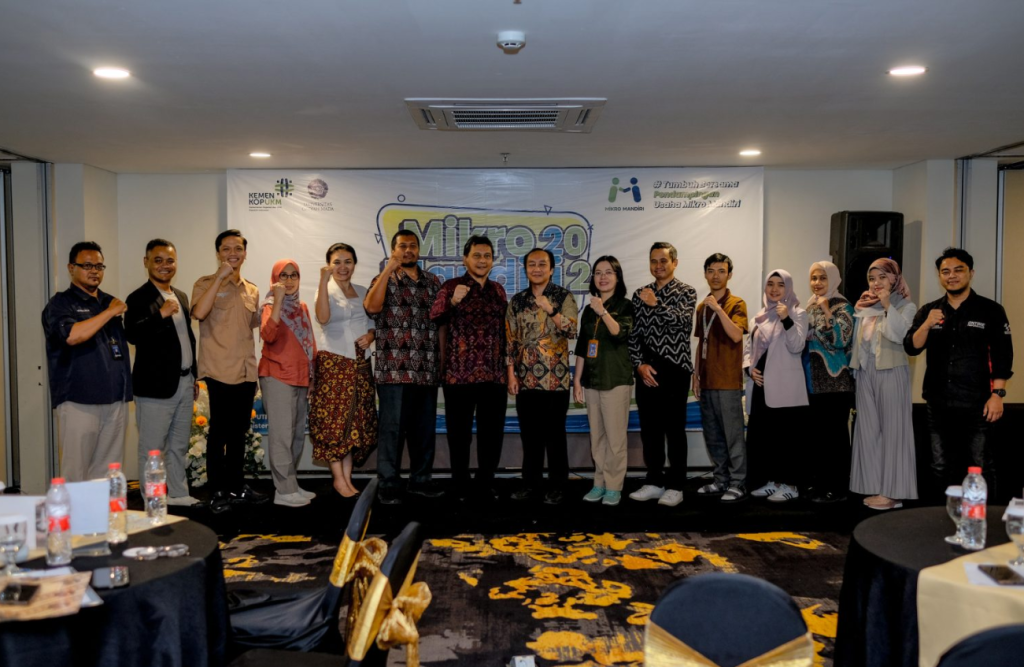
Sources: Mikro Mandiri 2024 Business Mentorship Program
Besides the online learning system, the University has facilitated business management training in order to strengthen the nation’s food sovereignty. The program is a collaboration between the Faculty of Animal Science UGM, the Indonesia Australia Red Meat and Cattle Partnership. This training involved participants from 10 provinces in Indonesia. The training materials covered cattle farming models in Indonesia; business planning, product marketing, and business economic analysis; gender equality and changes in the livestock farming paradigm; livestock health management; livestock feed management, breeding and fattening management; and commercial business presented by livestock business actors. This agenda is an annual agenda that involves farmers so that they can expand their knowledge about the development of cattle farming businesses in Indonesia.
Free access to UGM Library
The library has open access, and there is a collection guide in the library ranging from textbooks, references, periodicals, final works, theses, dissertations, scientific works, and so on. The integrated catalogue can be accessed in Online Public Access Catalog (OPAC), the final works in the repository, the open journal system for public, e-book, and e-resources for supporting the data. Users’ profiles can be identified in the Portal SNI Corner to find the SNI resources.
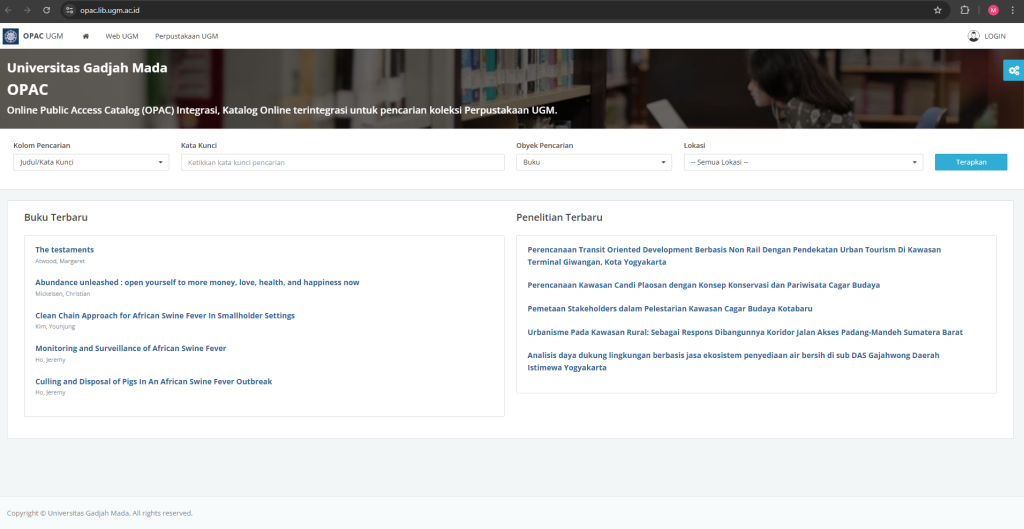
Sources: Online Public Access Catalog (OPAC)
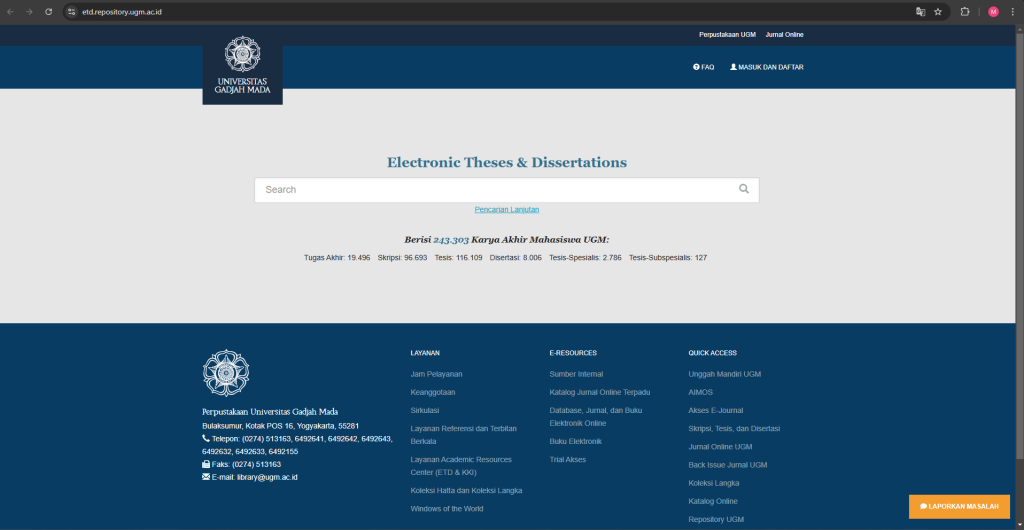
Sources: Electronic Theses & Dissertations (ETD)
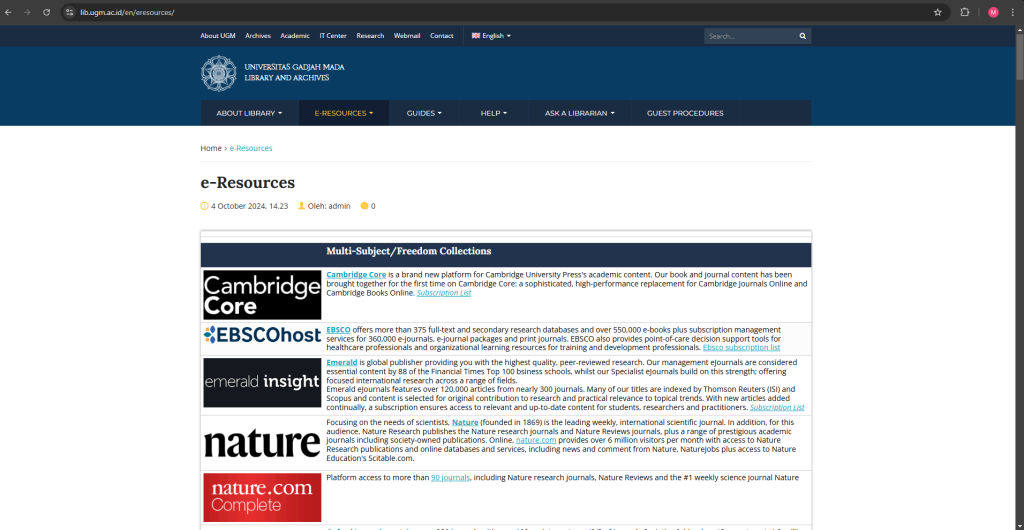
Sources: Open Access Online Resources
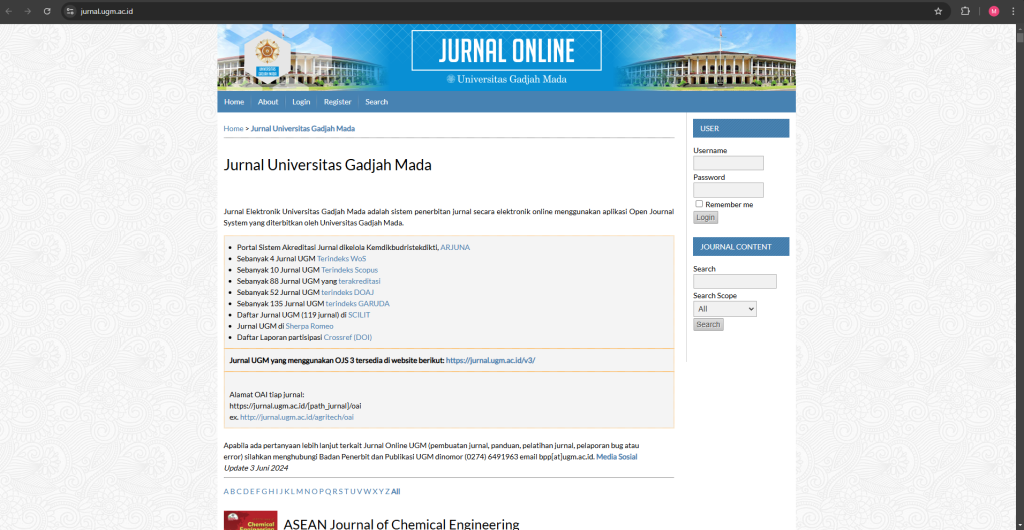
Sources: Jurnal Universitas Gadjah Mada
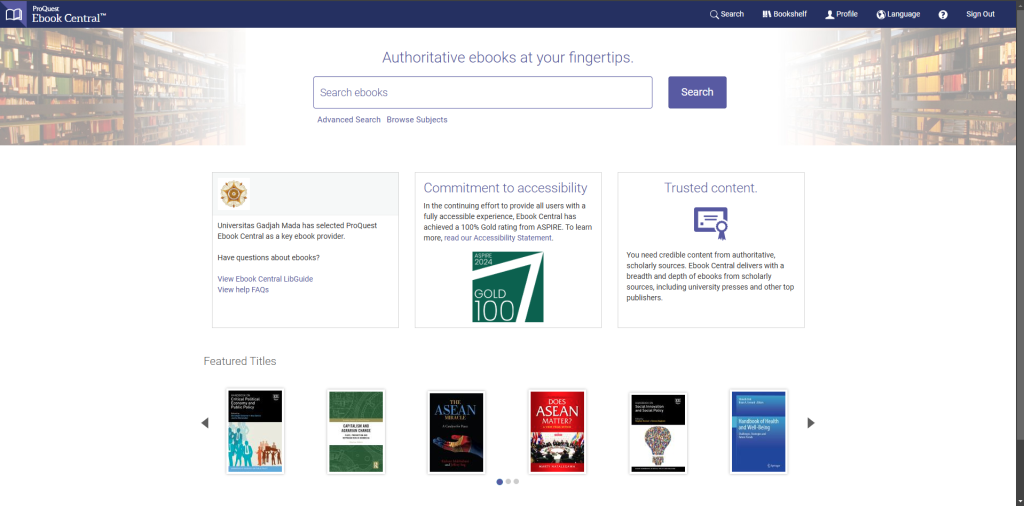
Sources: https://ebookcentral.proquest.com/lib/ugm-ebooks/home.action
The university also has Koleksi Langka, a rare collection of universities, which is an online repository managed by the library and contains digitised results of the available collections.
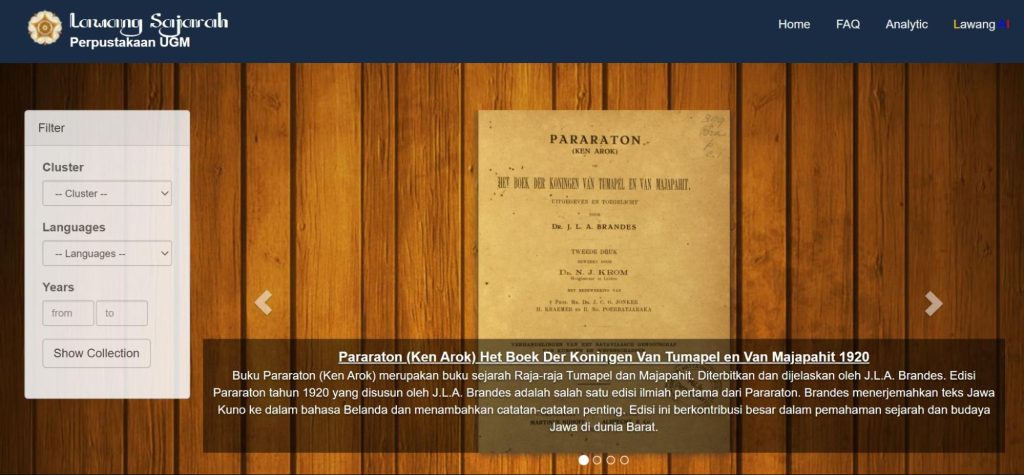
Sources: Koleksi Langka
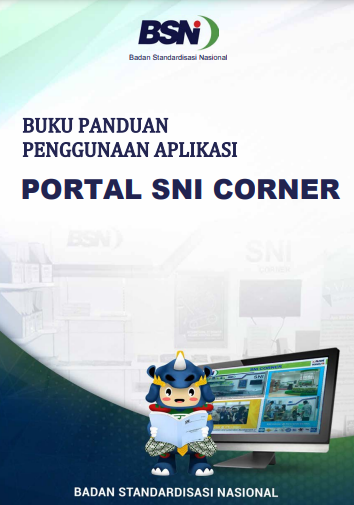
Sources: https://lib.ugm.ac.id/file/panduan-portal-sni-corner/.
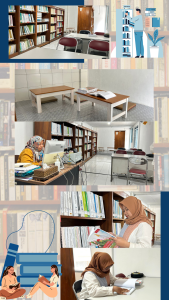
Sources: https://puspar.ugm.ac.id/halaman/perpustakaan-puspar-ugm/
Tourism Study Center Library Services in UGM are open to the public. Puspar’s library is recognised by many parties as an important place for the process of enriching and strengthening the capacity of institutional members and people from outside the institution who want to study tourism issues. To support various research activities, workshops, and training, the library has an important role in preparing relevant literature for each activity.
To produce quality research at UGM, the university facilitates research tools which are listed on the UGM Main Library website so students, staff, and faculty can easily access these tools.
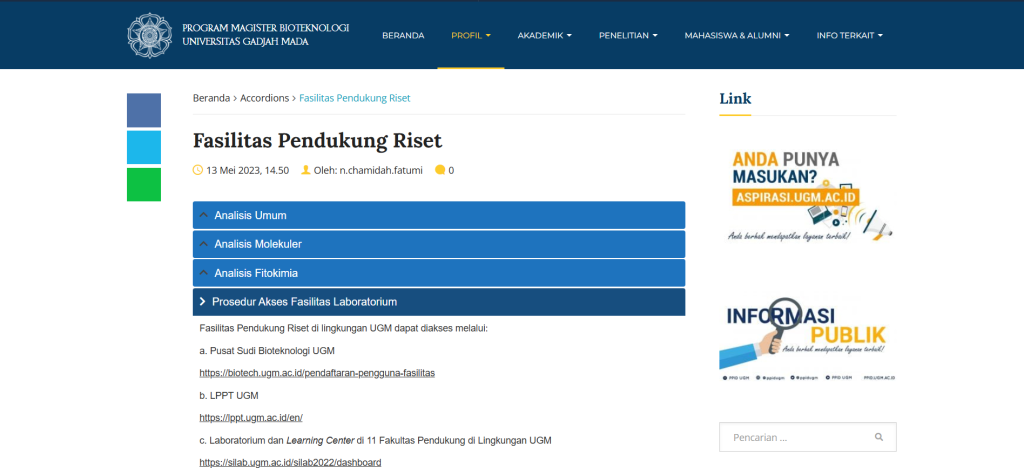
Sources: https://magisterbioteknologi.pasca.ugm.ac.id/accordions/__trashed-2/
Fabrication Laboratory Jogja UGM
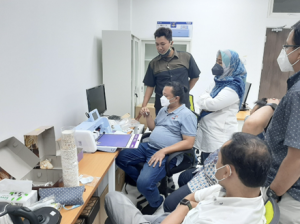
Sources: https://fablabjogja.ditpui.ugm.ac.id/en/training/
The university also provides training at the Fabrication Laboratory Yogyakarta on fabrication and material processing using a Laser Cutting machine.
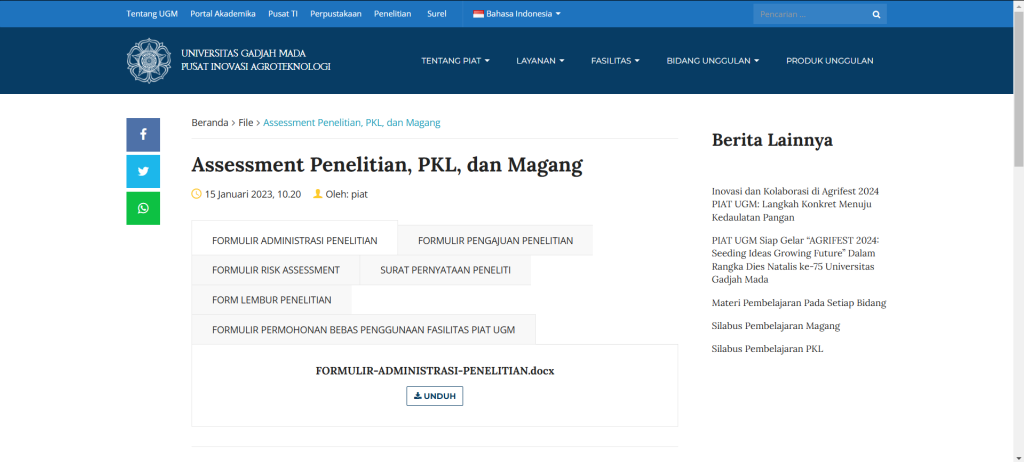
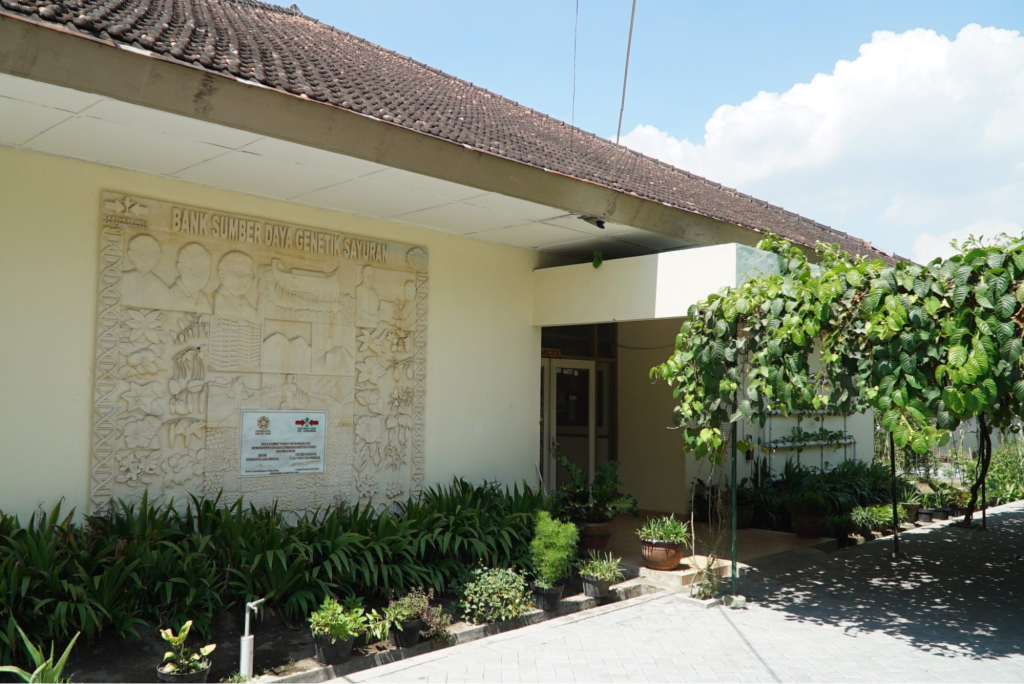
The Agrotechnology Innovation Center UGM actively facilitates visits, internships, and research collaborations with various institutions. This engagement aligns with PIAT’s mission to serve as an integrated academic service centre in agrotechnology, fostering innovation and practical applications in the agricultural sector. Information related to research and internships is available on the website (Internships at PIAT). Among the facilities at the centre is the Gene Bank, which is a collaboration between UGM and PT East West Seed Indonesia to conserve the diversity of Indonesian vegetable genes. It was established in 2018 as the Tropical Vegetable Research and Development Centre.
LPPT UGM
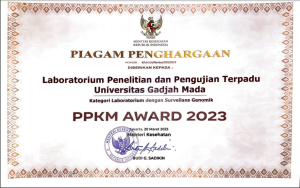
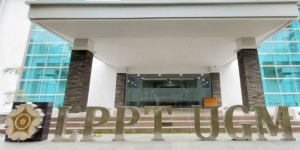
In 2023, Integrated Research and Testing Laboratory (LPPT) UGM provides various trainings that are free of charge or funded as a form of grant from other institutions. LPPT UGM received an award from the Indonesian Minister of Health for the best laboratory category in genetic surveillance testing. LPPT collaborates with a team from FKKMK UGM to analyse samples either by using PCR or genomically with Next Generation Sequencing (NGS).
References :
Free courses leading to certificate or award:
- MOOC
- Strategic Plan 2022-2027
- Quality Assurance in Higher Education
- Massive Open Online Courses (MOOCs) international collaboration
- e-LOK UGM
- Biobank FKKMK
- Artificial Intelligence
- 193,000 targeted students in 2024
- FOCUS UGM
- Mikro Mandiri 2024 Business Mentorship Program
- the Faculty of Animal Science UGM training cattle farming models
Free access to UGM Library:
- The Library UGM
- Repository UGM
- Jurnal UGM
- e-book UGM
- e-resources UGM
- OPAC UGM
- ETD UGM
- Koleksi Langka UGM
- Portal SNI Corner
- Tourism Study Center Library UGM
- Research Support Facilities UGM
- Fabrication Laboratory Jogja UGM
- Research Assessment in Agrotechnology Innovation Center
- Bank Genetic in PIAT
- LPPT UGM Award