
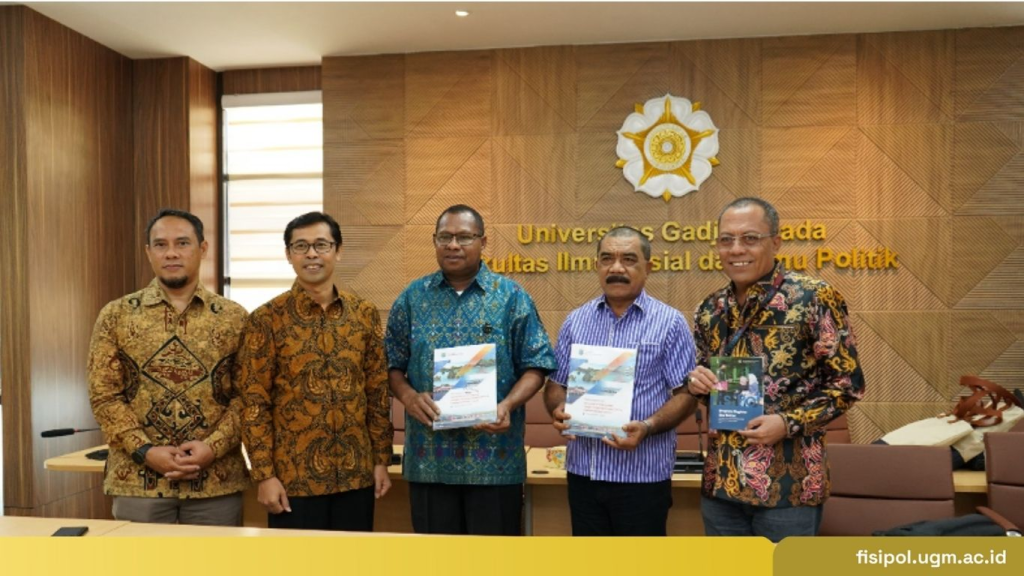
Policy making at the local and regional level
Poverty has become a target indicator of regional development performance. Therefore, poverty alleviation strategies need to be formulated into work plans or incorporated into the regional medium-term development plan of Indonesia’s local and regional governments. UGM plays the most active role in the Special Region of Yogyakarta (DIY), due to its location. This active role has been recognized with an award from the Regional Government. Poverty also has many dimensions and its approach involves various fields of study. Hence, local governments have consulted with UGM through multiple academic disciplines.
Our faculties and centers of excellence have actively participated in policymaking to end poverty, among them the Faculty of Social and Political Sciences, Faculty of Geography, Faculty of Law, Faculty of Economics and Business, the Center for Planning and Development Studies, and the Office of Sustainability. Several collaborations with district governments have produced policies and regional work plans, including:
- The 2025-2029 Ketapang Regency Regional Poverty Alleviation Plan (RPKD) was prepared as a form of synergy between various poverty alleviation programs.
- Regional Medium-Term Development Plan (RPJMD) 2025–2029 for Raja Ampat Regency becomes a strategic document and political instrument for medium-term development that will determine the region’s priority directions for the next five years.
- The 2025–2029 Regional Poverty Alleviation Plan (RPKD) for Bintan Regency was prepared to align with regional development planning.
- Preparation of the Final Draft and Academic Paper for the Regional Long-Term Development Plan (RPJPD) of Yapen Islands Regency for 2025–2045.
- Preparation of the Technocratic Draft of the Regional Medium-Term Development Plan (RPJMD) of Jembrana Regency for 2025–2029.
- Preparation of the Regional Long-Term Development Plan (RPJPD) Document of Denpasar City for 2025–2045.
Policymaking at the National Level
UGM became one out of 16 universities in the Special Region of Yogyakarta province that signed a Memorandum of Understanding (MoU) with the Ministry of Social Affairs to strengthen the long-term impact of the Family Hope Program (PKH) beneficiary families. This program was established to strengthen collaboration in accelerating poverty alleviation through social empowerment in which universities contribute to scientific and participatory approaches.
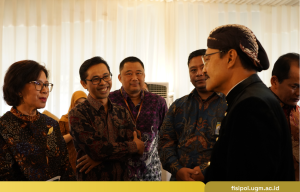
Source: UGM is ready to be a strategic partner of the Ministry of Social Affairs
The Ministry of Social Affairs (Kemensos) graduated 1,000 beneficiary families of the Family Hope Program (PKH) who received social assistance. The social assistance included capital assistance, business support, raw material assistance, as well as training to enhance the families’ entrepreneurial capacities. Through the Faculty of Social and Political Sciences, UGM proposes a longitudinal study to follow their life journeys for five years post-graduation. UGM is ready to be a strategic partner of the Ministry of Social Affairs in designing social empowerment policies and programs that are more impactful, inclusive, and sustainable.
Policymaking at the Global Level
Hundreds of experts, academics, and professionals from around the world gathered at the 4th Biennial Emerging Scholars Colloquium and Conference on Accounting and Accountability in Emerging Economies (AAEE), held on June 25–27, 2025, in Bali. A total of 155 participants from 5 continents and 17 countries presented and discussed research findings on accountability and sustainable development in developing countries. Among the experts were representatives from South Africa, Australia, Bangladesh, the Philippines, Canada, South Korea, the United Kingdom, Ireland, Japan, Malaysia, Nigeria, Papua New Guinea, Palestine, Saudi Arabia, Uganda, and Jordan.
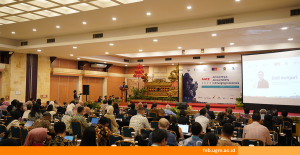
Source: UGM joins policymakers in AAEE
AAEE 2025 marked a historic moment as the forum was held in Indonesia for the first time, having previously always been hosted in the United Kingdom. This year, UGM’s Faculty of Economics and Business and Udayana University served as co-hosts in collaboration with the University of Essex. UGM joined policymakers and engaged in cross-border dialogues concerning the emerging economies of developing countries.
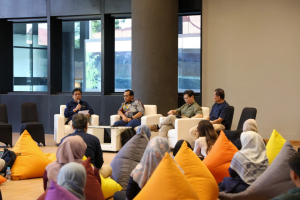
Source: A collaborative mission meeting
In 2024, UGM hosted a collaborative mission meeting with the Asian Development Bank (ADB) under the PRIME STeP (Promoting Research and Innovation through Modern Science Techno Parks) Project, which aims to accelerate innovation ecosystems in Indonesia’s universities. Projects funded included: Gamagora 7 rice seed development (a low-input, high-yield variety addressing food security and farmer income — directly tied to poverty alleviation), Mental health startups, Wise management applications, and Agro-based biofertilizer innovations, which contribute to sustainable agriculture and rural development. These projects collectively demonstrate how UGM and the ADB collaborate in research that targets multiple SDGs, including poverty reduction.
References:
- Award from the Regional Government
- Center for Planning and Development Studies
- 2025-2029 Ketapang Regency Regional Poverty Alleviation Plan (RPKD)
- Regional Medium-Term Development Plan (RPJMD) 2025–2029 for Raja Ampat Regency
- 2025–2029 Regional Poverty Alleviation Plan (RPKD) for Bintan Regency
- Ministry of Social Affairs (Kemensos) graduated 1,000 beneficiary families
- UGM is ready to be a strategic partner of the Ministry of Social Affairs
- UGM joins policymakers in AAEE
- A collaborative mission meeting