
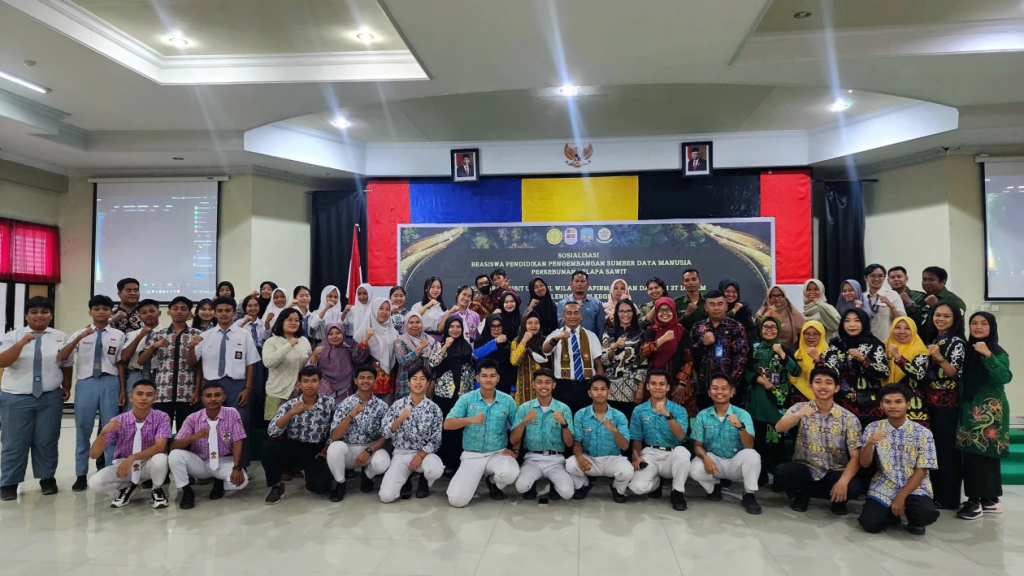
Source: UGM Engages in North Kalimantan to Expand Educational Access in 3T Regions
In March 2025, the National Office of Statistics recorded 11% of Indonesia’s total population—approximately 23.85 million people—were living below the poverty line. Among them, 10% were of age to enter higher education (university or college). Unfortunately, financial barriers continue to discourage many students from enrolling in university.
To expand access for these Indonesian youth, the Indonesian government established the Kartu Indonesia Pintar Kuliah (KIP Kuliah) program, a continuation of the Bidikmisi program that ran from 2010 to 2022. The main target of the KIP Kuliah program is to assist students with academic achievements from low-income families in pursuing higher education without financial burden. In 2024, the government awarded 101,000 students for KIP Kuliah scholarships across Indonesia.
In 2024, a total of 40,390 undergraduate students were enrolled in UGM. Of this number, 8,955 students, or 22.17%, were recipients of KIP Kuliah assistance. UGM has contributed in supporting 8.9% of the government’s KIP Kuliah recipients nationwide. This is part of UGM’s admission strategy targeting students who fall into the bottom 20% of household income group in the country.
All public universities in Indonesia have implemented the UKT system since 2013. UKT stands for the Single Tuition Fee (Uang Kuliah Tunggal), the tuition fee that students are required to pay each semester. Students only need to pay tuition once per semester, with a fixed (flat) amount that remains the same throughout their period of study. The government applies a cross-subsidy scheme based on each student’s economic background. Students with stronger financial capacity are assigned higher tuition fees, allowing those from wealthier families to indirectly subsidize the education of students from less advantaged economic backgrounds. The implementation of this cross-subsidy system divides UKT into several levels; Zero subsidy, 25% subsidy, 50% subsidy, 75% subsidy, and 100% subsidy. This allows students from various economic conditions to access higher education, including those who come from the bottom financial quintile.
UGM is the oldest and one of the largest public universities in Indonesia. Each year, UGM sets a targeted number of students receiving tuition fee subsidies—meaning students who receive the 25% until 100% subsidy—per faculty. In 2024, 21,517 students at UGM received the 25% to 100% subsidy tuition fees, accounting for 53% of the total students enrolled.
Students registered under KIP Kuliah assistance are eligible to apply to UGM through the Selection of Outstanding Economically Disadvantaged Students (Penelusuran Bibit Unggul Tidak Mampu or PBUTM) admission track. The combined gross income of the parents/guardians responsible for tuition fees must not exceed IDR 4 million per month, the combined gross income per family member must not exceed IDR 750 thousand per month, and the parents’ or guardians’ highest educational attainment must be a bachelor’s degree (S1) or diploma four (D4).
There are two other admission tracks available for students from the bottom household income group; namely the Selection of Outstanding High-Achieving Students (Penelusuran Bibit Unggul Berprestasi or PBUB), and Selection of Affirmative and 3T Region Students (Penelusuran Bibit Unggul Afirmasi dan Daerah 3T ).
Indonesia is the world’s largest archipelagic island nation with over 17 thousand islands. It is understandable that development in remote regions is slower than others. These regions are called the 3T regions (3T stands for tertinggal, terdepan, and terluar) and they are the less developed and less populated regions of Indonesia.
UGM has prepared the PBU 3T pathway specifically targeted at students from these regions. Partnering with local governments and organizations, UGM identifies students with leadership and academic potential from high schools that meet accreditation standards. This initiative not only promotes educational accessibility but also aligns with national development objectives by nurturing young talents from remote areas.
The PBU 3T program places a strong emphasis on leadership skills and academic potential, requiring candidates to meet high school accreditation standards and obtain nominations from their principals. Through partnerships with local governments and organisations, UGM seeks to identify and assist potential students from these communities.
To give a chance for students from the 3T regions to register at UGM, UGM held the UGM Entrance Examination CBT 2024 in 7 cities throughout Indonesia. A total of 41,973 participants took part; of these, 32,414 participants sat the test in Yogyakarta, while 9,559 took the exam in six other Indonesian cities: Jakarta, Kupang, Balikpapan, Medan, Pekanbaru, and Makassar. These cities are located in Sumatra, Java, and Sulawesi islands, and were selected to approach students who wish to study at UGM without needing to travel to Yogyakarta.
UGM will continue to expand equitable access to new student admissions for Indonesia’s outermost regions through the Penelusuran Bibit Unggul (PBU) Affirmation Track for Disadvantaged, Frontier, and Outermost Areas (3T). Therefore, in the coming years, the university may open more test centers in various regions. UGM is currently considering the possibility of conducting the UGM Entrance Examination in Papua. This will certainly provide wider opportunities for Papuan students who wish to study at UGM.
To encourage more and more regions and students to apply to UGM through the Penelusuran Bibit Unggul (PBU) Affirmation and 3T pathway, UGM sends representatives to hold socialization programs. Such an effort was realized through a socialization program conducted at the University of North Kalimantan on May 16th, 2024, in collaboration with the Provincial Office of Agriculture and Food Security of North Kalimantan.
References:
- Kartu Indonesia Pintar (KIP) Kuliah Program
- Government Awards 101,000 students with KIP-K
- UGM Opens Registration for Outstanding Students through PBU Track for Economically Disadvantaged, Affirmation, and 3T Regions
- UGM Continues to Expand Equitable Access to New Student Admissions
- UGM Engages in North Kalimantan to Expand Educational Access in 3T Regions