
Universitas Gadjah Mada (UGM) has established a long-term commitment to becoming a sustainable campus and achieving net-zero emissions by 2050. This strategic goal is outlined in the UGM Strategic Plan 2022–2027 (p. 46), with a primary focus on reducing emissions generated from campus transportation and building operations. Based on the 2021 baseline emission record of 709.82 metric tons of CO₂, UGM has set progressive reduction targets, aiming to reach 689 metric tons by 2024 and 659 metric tons by 2027. As a demonstration of transparency, institutional responsibility, and strong environmental governance, Since 2018 the university has reported its carbon emissions following both the GHG Protocol Corporate Standard and the US EPA Government Emission Standard.

Currently, UGM’s carbon accounting framework includes emissions under Scope 1 and Scope 2. Scope 1 covers emissions generated from operational university-owned vehicles and official staff travel. As of 2024, a total of 220 fossil-fuel-powered vehicles are used on campus operations, contributing an estimated 41 metric tonnes CO2e/yr. Meanwhile, Scope 2 emissions include those produced from electricity consumption derived from both conventional fossil-based energy sources and renewable energy. In 2024, UGM’s total electricity consumption reached 71,989 GJ, with 5,285 GJ sourced from renewable energy. Calculations show that this consumption resulted in 16,120 and 59 metric tonnes CO2e/yr, respectively, bringing the total Scope 2 emissions to 16,179 metric tonnes CO2e/yr. Operational electric vehicles are also categorized under Scope 2, as their charging activities depend on the campus electricity supply.
In Summary, UGM’s total carbon footprint tracking per Year is obtained by :
= total emission from electricity usage + transportation (fossil-fueled motorcycles and cars)
= 16,797.44 metric ton + 1,074.80 metric ton + 367.91 metric ton
= 18,240.15 metric ton
Therefore, the amount of carbon footprint per year per person in 2024 is 18,240.15 metric tons / 72,564 person, which equals 0.25 metric tons/person
This emission calculation reinforces UGM’s commitment to transparency and accountability in addressing global warming and climate change. The Scope 1 and Scope 2 carbon reports serve as essential tools to monitor the university’s environmental impact and provide a foundation for future emission reduction actions. UGM also plans to expand its reporting framework to include Scope 3 emissions in the near future.
To be precise, the emission calculation we have so far is described as follows. The Scope 1 carbon footprint per person, only from UGM’s vehicles in 2024, is 0.001 metric tons/person. For Scope 2, considering only the total energy consumption from electricity usage is 0,223 metric tons/person. Meanwhile, for Scope 3, counting the commuting vehicles owned by UGM’s people only, is 0.035 metric tons/person. However, this Scope 3 is still ongoing since not all the vehicles are already registered with their daily commute to campus.
Additionally, in early 2022, UGM developed a digital Energy and Climate Monitoring System, which was fully deployed by the end of the same year. Designed as a real-time monitoring platform, the system records energy consumption, carbon emissions, and the use of low-carbon energy sources, including solar power installed across various faculties and administrative units. By leveraging automation infrastructure and IoT- and ICT-based data processing, the system provides detailed insights into the energy consumption profile of each building—enabling the identification of operational trends, peak usage periods, inefficiencies, and potential optimization areas.

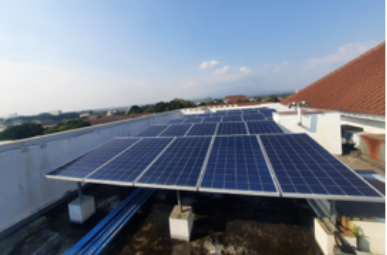
Solar Panel Installation.

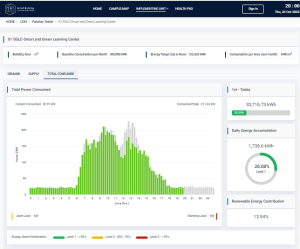
A Real-time Energy Monitoring System is integrated into several buildings via the Building Management System (BMS).
(https://smartcampus.ugm.ac.id/building)

Figure 3. Solar Panel Production at UGM
The system provides comprehensive analytics on energy use patterns and identifies factors that contribute to increased emissions or inefficiencies. The collected data enables UGM to evaluate the energy performance of each department and formulate targeted strategies for future energy optimization and emission reduction. The system’s ability to track performance down to the building or departmental level strengthens sustainability-related decision-making across campus. Through this integrated approach, UGM is able to measure and manage its environmental impact with transparency, in alignment with globally recognized sustainability and reporting standards.
References: