
UGM was first built in 1952 in Bulaksumur, Sleman Regency, Special Region of Yogyakarta. At that time, the area was predominantly rural; however, with the rapid urban development of Yogyakarta, it has since evolved into a bustling urban environment. Given the ample land availability during its early development, there are no brownfield sites with serious pollution or contamination concerns within the university.
However, the area around Sardjito Hospital, a public hospital located next to the Faculty of Engineering, is bordered by the Kuning River. The river faces a potential risk of contamination from medical waste produced by the hospital. Another area on campus with possible risk of contamination is the vicinity of the life sciences laboratories, where research activities may involve biological or chemical materials that could be harmful to the environment if not properly disposed of. In addition, the Kuning river bank bordering the southern side of the hospital and the Faculty of Engineering was previously used as a landfill site, posing further risks of soil and water contamination.
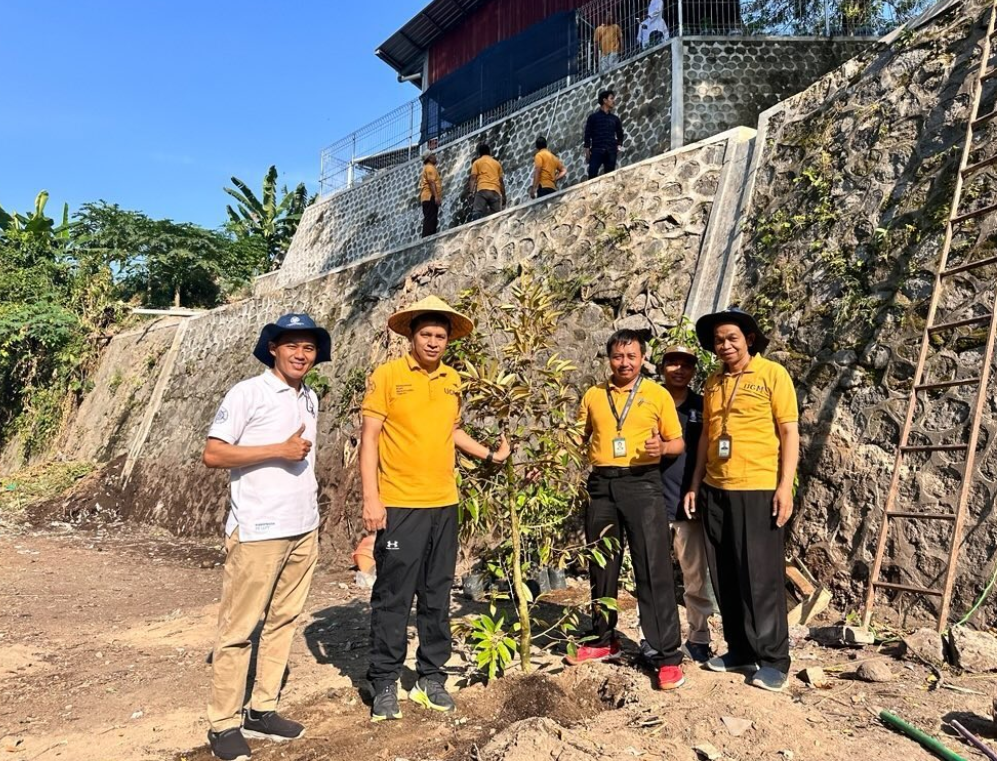
To address these potential environmental risks, UGM has undertaken several land rehabilitation initiatives. In 2024, UGM began transforming the idle piece of land into a productive green area by planting a total of 22 trees. The species of trees chosen were fruit trees with woody trunks—such as mango, guava, longan, rambutan, and durian—that can live for a long period of time. The trees were planted using compost fertilizer produced by the Faculty of Engineering’s very own Reduce, Reuse, Recycle Waste Management Site “Grahakara Grafika”.
These green transformation efforts extend beyond the riverbank. The former UGM Bookstore building had been abandoned for nearly 20 years after being declared by the local government as structurally unfit for use and failing the functional feasibility test. Licensing issues, including insufficient setback distance from the permitted boundary line and inadequate structural integrity, contributed to its disuse. The building has since been demolished and will be converted into a green open space area that also serves as the western entrance to the newly constructed Gelanggang Inovasi dan Kreativitas (GIK) building.
References: