
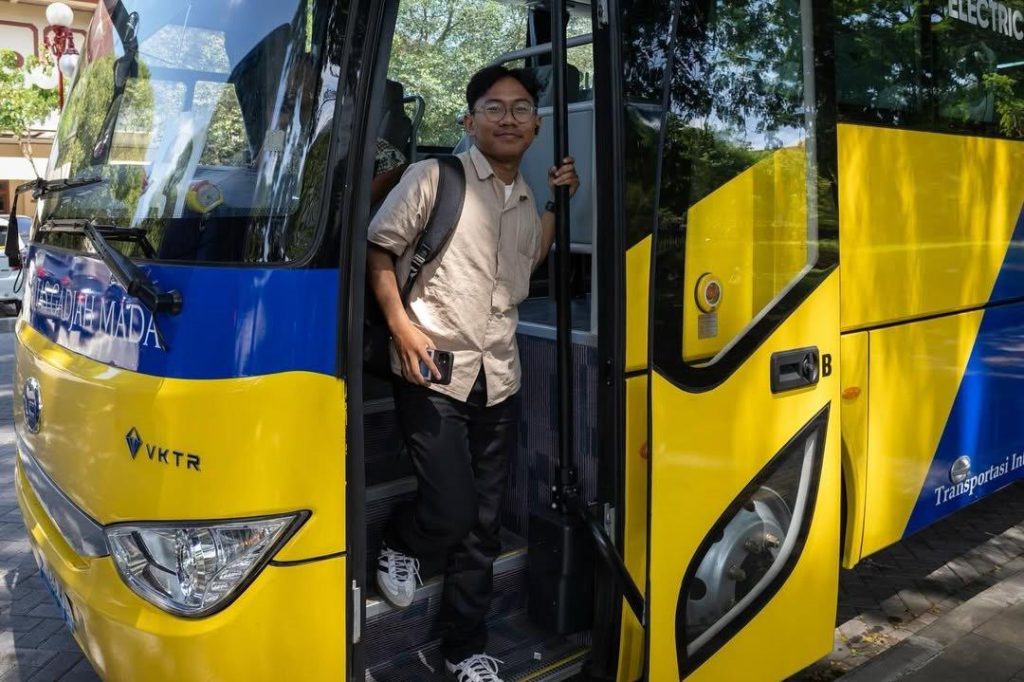
Transportation is the second-largest source of global greenhouse gas emissions with current levels almost double what they were in the 90s. Emissions from transportation will continue to increase unless effective changes are made. These changes are being made at UGM through steps to promote sustainable commuting practices on campus. UGM hopes to encourage its community of 72,000 students, staff, and faculty to ditch their cars and bicycles in favor of more sustainable alternatives like riding a bus, biking, or walking.
Campus Bicycle Program


At UGM, all students, staff, and faculty are able to borrow the campus bicycles for free. All you need to do is go to the nearest bicycle station (there are 11 stations spread across campus), register your ID, and off you go. The locations of these bicycle stations situated near parking areas and Trans Gadjah Mada bus stops are intended to encourage the university community to use private vehicles only for commuting to campus, while internal transportation needs can be accommodated through green transportation options.

To borrow a bike, the process is quite simple. Students and faculty only have to open the PIT UGM feature on their Simaster vNEXT app and they can immediately locate bicycle stations using the integrated map, borrow and return bicycles using QR code, and monitor their campus bicycle rental history.
Campus Bus Shuttle Program

The electric bus service is a free and comfortable option to get around campus. Passengers can easily reach the nearest bus stop from their building via shaded, walkable pedestrian pathways.

The route of the Trans Gadjah Mada bus can be accessed in the SIMASTER vNEXT phone application. Passengers can view bus routes, locate the nearest bus stop, and track the current location of the bus on each route.
Pedestrian Pathways

The pedestrian pathways are designated walkways designed for any person walking through campus to travel on foot. The pathways are equipped with features to enhance the safety, comfort, and inclusivity for all pedestrians such as canopies, ramps and guiding blocks, street lamps, separators, crosswalks, and benches.
Program to Reduce the Number of Personal Vehicles in the UGM Area
Since it is difficult to prohibit using carbon emission vehicles entirely, reducing parking areas on campus is the next step to encourage switching to green transportation options. In 2024, UGM maintained its total parking area at 39,559.99 m², the same as the previous year, despite the annual increase in student admissions. This area sufficiently accommodates the parking needs of 66,253 students and 6,311 faculty and staff. Though parking area reduction has reached its limit (the ratio of ground parking area to total campus area is 0.17%, already < 1%), UGM is beginning to repurpose parking spaces into green open spaces and water absorption areas.

UGM has put in place a Centralized Parking Program wherein UGM’s students must park their private vehicles either within faculty designated parking or the 9 centralized parking areas. These 9 pockets for parking are divided into those for motorcycles or cars or both, each with specific capacity limits (ranging from 400 to 2,000 vehicles). There are additional parking restrictions within faculty and certain administration office premises.

The campus entrance gates are fitted with sensor-based vehicle counters to record the number of vehicles (both cars and motorcycles) entering and exiting campus. Card-tap access portals at the Faculty of Engineering restrict entry and exit exclusively for authorized faculty members, whilst also calculating the number of vehicles entering and exiting the premises.
Government Programs
UGM has been commended by the Indonesian Minister of Transportation through initiatives such as the Campus Bicycle Program, electric buses, and research groups that have successfully patented recycling technology for processing lithium battery waste from electric vehicles of various types. The Rector of UGM received an award at the Hub Space X KAI Expo 2023, presented directly by the Minister of Transportation. The award was given to individuals and institutions who have contributed to the development of connectivity and transportation in Indonesia. UGM’s concern for transportation issues can be seen through the wide range of research conducted by its scholars which has greatly assisted the government in improving both private and public transportation systems.
The Center for Transportation and Logistics Studies (Pustral) leads UGM’s research on sustainable transportation. Together with the Ministry of Communication and Information Technology, they jointly organized a Regional Workshop aimed to reach a consensus among ASEAN member countries regarding the development of a regulatory framework for the infrastructure and systems needed to support autonomous vehicles, as well as an action plan for cross-border digital data flow.

Researchers from the Faculty of Engineering have also developed the GATe electric car which runs on a lithium battery. This invention is already in use at both local and national levels. In Yogyakarta, the vehicle was used during a regional government event and also operates as a shuttle at the Yogyakarta International Airport (YIA). GATe has also been deployed at Soekarno-Hatta International Airport in Jakarta and is now listed in the national e-catalogue at https://e-katalog.lkpp.go.id/.
References: