
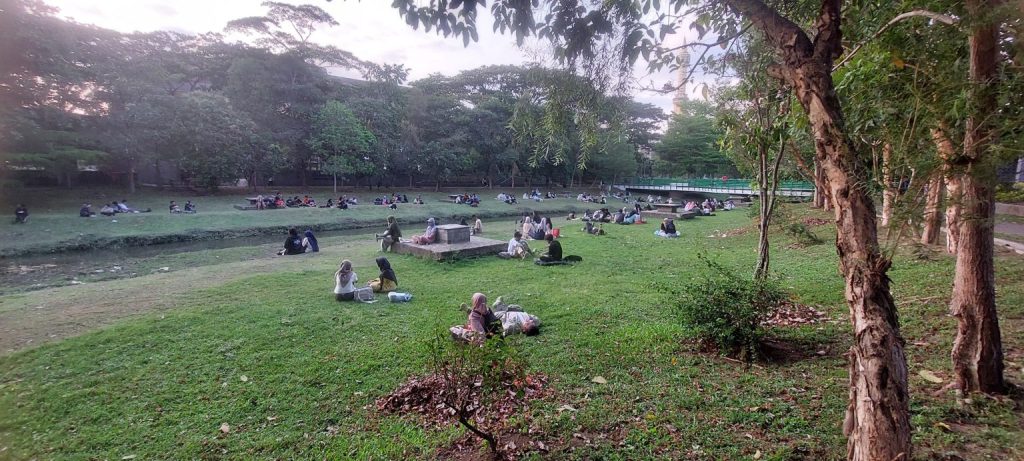
Open spaces and green spaces at UGM encompass outdoor areas free from buildings or infrastructure, providing natural environments such as grassy fields, courtyards, and gardens. These spaces serve as relaxing, studying, and activity hubs for students, faculty, and visitors, fostering a vibrant and sustainable campus community. In 2024, the ratio of open spaces toward total area is 97%.
The following table details the area of the open space areas and their accessibility for the public. These areas are spread across the university’s Main Campus and its four satellite campuses, which comprise the UGM Academic Hospital, Wanagama Eco-Edu Forest, PT Pagilaran, and the Agrotechnology Innovation Center (PIAT).

Open spaces and green spaces inside the Main Campus
UGM’s Main Campus in Bulaksumur has an extensive open space area of 1,243,108.62 m², or 69% of the total area.

Each faculty maintains its own gardens or courtyards. For example, Taman Canina is actively managed by the Faculty of Dentistry to support the health and well-being of the academic community. Active management includes adding facilities such as outdoor exercise equipment that can be freely used by anyone, as well as umbrella-shaded seating that provides comfortable spaces for discussion, studying, or relaxing.

Source: Canina Garden
Grassy spaces are also present around all office and public buildings, including the Main Library and the Central Building. Additionally, UGM has dedicated green open spaces in Wisdom Park and the Pancasila Field at UGM’s stadium. Some of the open space areas are planted vegetation, with an area of 400,954.00 meter square in the main campus and also forest area of 162,722.02 meter square. The largest forest areas inside the main campus are the Faculty of Biology Arboretum and the Faculty of Forestry Arboretum
Wisdom Park

Wisdom Park is one of the green open spaces inside the main campus area. In addition to supporting educational, research, and community service activities, the park is also available for the public to use for free as a place of exercise and relaxation. The area is home to 38 species of trees and offers indoor and outdoor sports facilities, a water reservoir, land conservation areas, and urban farming spaces. The 38 types of trees planted represent species native to various provinces in Indonesia, including Cinnamon, Puspa, Meranti Damar Hitam, Menteng, Nutmeg, Kenari, Clove, Biti Wood, Ulin, Saga, Ebony, Sandalwood, and Pasak Bumi.
Arboreta

The Arboreta houses a diverse collection of plants from across Indonesia, including 91 species of trees such as meranti (Shorea zeylanica, S. japonica), nagasari (Mesua ferrea), sterkulia (Sterculia foetida), and the yellow-flowering kapok pad (Salamalia malabarica), alongside various palm species. The forest has become a living environment for species of animals as well, such as snakes, dogs, cats, and mice.
Open spaces and green spaces in Wanagama
The Wanagama Eco-Edu Forest in Gunung Kidul District is one of UGM’s satellite campuses used as a place of research, field study, and conducting compulsory courses for students of the Faculty of Forestry. Wanagama is a forest situated in a karst area, which means the environment is typically dry and barren. However, this results in a unique diversity of flora and fauna. In addition to trees, the flora in Wanagama Forest includes ferns, epiphytes, various shrubs, and grasses. After initiatives to rehabilitate the critical land and conserve the forest, Wanagama is now home to at least 170 plant species, seven bamboo species, 47 bird species, and 17 herpetofauna species.
Open spaces and green spaces in PIAT
The UGM Agrotechnology Innovation Center (PIAT) has two main lands located in Berbah and Mangunan wherein besides its research buildings, the areas are mostly covered by open spaces of forests, plantations, and farms. The total open space area of PIAT Berbah and Mangunan is 1,833,922.50 m².
PIAT is a satellite campus that facilitates learning, research, and community service for UGM’s student and staff. Since there are several sub-fields of research in PIAT, each need their own fields, gardens, ponds, and other supporting facilities, which make up part of the open space areas. For instance, the Food and Horticulture Sub-field utilizes productive farmland, organic gardens, and advanced green facilities like screenhouses and vertical farming greenhouses. The Biodiversity Conservation Sub-Field manages genetic seed banks, orchid gardens, and tissue culture labs, while an edugarden offers outdoor educational spaces. There are also artificial ponds and water retention ponds (embung) to study water management.
Open spaces and green spaces in PT Pagilaran

PT Pagilaran is another campus satellite used as a teaching and research facility for UGM students and staff. The Indonesian government granted ownership and business rights to UGM on 8 February 1964 by decree of the Minister of Agriculture and Agrarian Affairs Number SK. VI/6/KA Year 1962. Pagilaran’s commodities include tea, cocoa, coffee, cloves, and quinine, which are all grown in an open space area of 12,905,400 m². As a teaching industry, the landscape is characterised by expansive rolling tea fields and tea and coca plantations, creating a vast, green environment.
Open spaces and green spaces in the UGM Academic Hospital

The UGM Academic Hospital is a hospital under UGM’s management that provides medical treatment and health services for the campus community (students, staff, and faculty), as well as for the public. The hospital has areas covered in planted vegetation totalling to 17,223.23 m². These areas include a courtyard in the center of the hospital, vegetation alongside parking lots and entryways, as well as lawns surrounding the hospital buildings.
Open spaces and green spaces in the Field Research Center

The Vocational School’s Field Research Center (FRC) is located in Wates, Kulon Progo Regency with an open area of 58,845 m². This area functions as a field laboratory and a multidisciplinary research center, particularly in the fields of agriculture, forestry, environmental studies, and technology. To support these functions, it is not surprising that the FRC includes several open spaces, such as a retention pond and fields.