
UGM is steadily advancing toward its vision of becoming a net-zero campus by 2050, aligning with Indonesia’s Enhanced Nationally Determined Contribution (NDC) targets, which sets emission reduction targets of 29% unconditionally, and up to 43.2% with international support, by 2030. UGM serves as a vital bridge and partner across academia, industry, and government to overcome fragmentation and support the implementation of both the NDC and national agendas for achieving the 17 SDGs. Through reducing building footprints, UGM is not only reducing its environmental impact but also setting a leading example for sustainable transformation in higher education.
For effective carbon management and carbon dioxide reduction, UGM calculates carbon emissions based on the GHG Protocol, covering Scope 1, Scope 2, and Scope 3 emissions. To date, UGM’s main initiatives have focused on calculating and controlling Scope 2 emissions and on efforts to reduce Scope 1 emissions, although the contribution of all carbon sources has not yet been comprehensively assessed.
The carbon reduction and emission reduction process for Scope 1 emissions involve direct emissions from fuel combustion; operating EV shuttles on campus and placing parking restrictions. As for reducing Scope 2 emissions, in other words, indirect (purchased) emissions, several of our buildings operate solar power plants, meanwhile comprehensive studies on renewable energy sources remain a priority among our researchers.
By optimizing UGM’s building designs that focus on energy efficiency infrastructure and reducing excessive footprints by providing green transportation within the campus, UGM can significantly reduce carbon emissions.
Scope 1: Direct emissions from fuel combustion
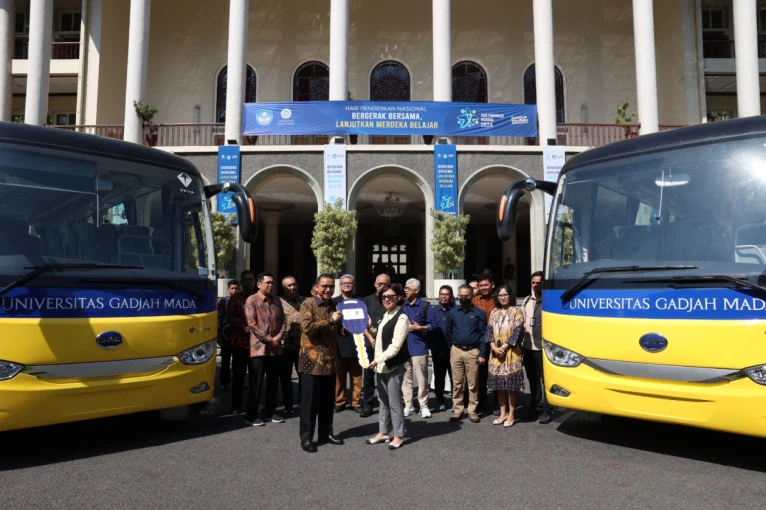
Scope 1 emissions are primarily generated by the vehicles of UGM’s students, staff, and faculty as well as UGM-owned vehicles that still run on fossil fuels, amounting to 1,491.52 metric tonnes of CO₂e per year. This figure has begun to decrease with the gradual introduction of our green transportation system with electric vehicle shuttle services operating seamlessly throughout the campus. We have the Trans Gadjah Mada electric bus as our primary eco-friendly transportation choice, not to mention the electric car shuttles for staff, faculty, and guest mobility.

In 2024, a total of 47,499 passengers used the Trans Gadjah Mada bus which operates on Mondays to Fridays from 6.00 a.m. to 4.00 p.m on 3 routes. The routes can take passengers to all faculties and office buildings and has been integrated with other green transportation options available on campus, such as the bicycle stations. Bus stops are also found near parking lots and the city’s public bus network, Trans Jogja.

Besides the bus, UGM also offers 8 electric cars as part of its campus shuttle service that have a cruising range of up to 50 km. These electric car shuttles are used by staff, faculty, and visiting guests for getting around campus buildings and surrounding areas, or for campus events that require mobility.
The UGM Electric Shuttle Service has 3 sizes of cars that can seat 3 to 12 people, depending on the number of passengers needed to be transported. The Gadjah Mada Airport Transporter Electric (GATe) is an electric vehicle developed by UGM’s very own researchers. It was originally designed for airport passenger transport but is now also used as an electric shuttle at the Faculty of Engineering. The vehicle was officially listed in the national e-catalog in 2023.
UGM has also implemented policies to reduce parking area as part of its strategy to minimize carbon emissions and encourage sustainable mobility on campus. By limiting parking spaces, the policy aims to discourage the excessive use of private vehicles and encourage people to walk, cycle, or use the EV shuttles.

For instance, UGM has put in place a centralized parking regulation requiring UGM’s 66,253 students to park their private vehicles within either faculty designated parking or within the 9 centralized parking areas. These parking areas are strategically located at several key entry points around the perimeter of the main campus, each with specific capacity limits for cars and motorcycles.

Several faculties have their own parking restrictions. The parking areas within the Faculty of Agricultural Technology (FTP) are designated exclusively for the faculty’s members. All staff motorcycles parked within the faculty area must have a parking permit.


At the Faculty of Engineering, card-tap access portals are used to control entry and exit exclusively for authorized students, staff, and faculty members. The system also records the number of vehicles entering and exiting the faculty daily.
Scope 2 : Indirect (purchased) emissions

UGM utilizes electricity sourced from both the national grid (PLN) and renewable energy sources.
- In one year, the amount of electricity sourced from the national grid totals to 19,996,953.48 kWh (based on 2024 calculations).
- Meanwhile, the electricity generated from wind power (730 kWh), biogas (2,737.5 kWh), solar photovoltaic (1,432,515.5 kWh), and a micro-hydro power plant (32,032.4 kWh) brings the total renewable electricity production to 1,468,015.4 kWh, accounting for approximately 7.34 % of the total electricity used across the campus. This amount is equivalent to a carbon emission reduction of 1,233.13 tons of CO₂ (emission factor 0.85 tons/kWh) or equivalent to having 56,051 adult trees planted (tree absorption 22 kg CO₂/tree).
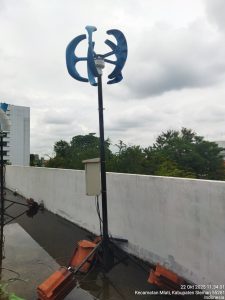
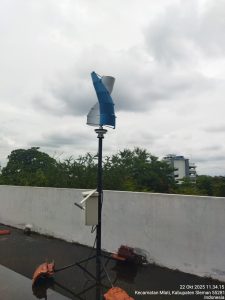
The wind power plant at the Department of Nuclear Engineering and Physics has a capacity of 2 kWh/day.

The micro-hydro power plants are located at the Faculty of Engineering and the UGM Academic Hospital (RSA).

The Biogas Power Plant is located at three points, namely the Faculty of Animal Husbandry, PIAT, and the Faculty of Veterinary Medicine.
Meanwhile, as many as 23 solar power plants are installed on the rooftop of our campus buildings. This process has produced over 1,432,515.50 kWh of electricity in 2024, equivalent to a carbon emission reduction of 1,217.64 tons of CO₂ (emission factor 0.85 tons/kWh) or equivalent to having 55,348 adult trees planted (tree absorption 22 kg CO₂/tree).
A detail of the solar power plants installed onto UGM buildings and the electricity produced is provided in the table below:

Below are images of solar PVs installed on campus:

Solar PV installed on the Home wood/Net zero Emission Building (capacity of 0.83 kWh/day)

Solar PV installed on the Faculty of Biology Mosque (capacity of 8.7 kWh/day)
References: