
Water-Efficient Landscaping at UGM: Implementing Drought-Tolerant Plant Strategies
UGM’s landscape includes the Biological Forest, with around 91 plant species such as Asoka and Meranti trees, enhancing biodiversity and aesthetics. The Faculty of Forestry’s arboretum and Gadjah Mada Forest feature native plants and provide ecological benefits. In 2023, UGM planted 13 new tree species to support biodiversity and climate change mitigation.
Application of landscape plants
The establishment of the Hoya Garden at PSLH UGM aims to cultivate interest and foster active participation among the academic community and institutional partners. Hoya plants are well suited for sustainable landscaping due to their water-efficient characteristics; their thick, succulent leaves enable effective moisture retention, reducing the need for intensive irrigation. As one of Indonesia’s important germplasm resources, hoya species hold significant conservation value. In this regard, PSLH UGM is committed to preserving and cultivating hoya plants as a national asset that is increasingly recognized internationally. These varieties are water-friendly plants that require minimal water and therefore support water conservation efforts.
The Faculty of Animal Science likewise supports water conservation principles through the implementation of water-efficient landscaping across its campus grounds. Its landscape design strategically incorporates drought-tolerant and highly adaptable plant species to minimize maintenance-related water consumption. Species commonly used in the Fapet environment include golden ketapang (Terminalia mantaly), tabebuya (Handroanthus chrysotrichus), king palm (Roystonea regia), mother-in-law’s tongue (Sansevieria trifasciata), and various ground cover plants such as mini elephant grass. These varieties are water-friendly plants that require minimal water and can therefore contribute significantly to campus-wide water conservation while enhancing landscape aesthetics.
Similarly, the Faculty of Psychology integrates water-efficient vegetation into its green spaces. Plant species such as bromeliads, sansevieria, bougainvillea, and frangipani were selected because they are water-friendly varieties that do not require substantial irrigation and support the faculty’s commitment to sustainable landscaping. Through these initiatives, the faculty contributes to promoting environmentally responsible campus vegetation management and advancing UGM’s broader sustainability agenda.
UGM Biological Forest
The Biological Forest protects, recreates, and aesthetics and provides other functional benefits to urban communities, especially those in the UGM area.
In 1972, this Biological Forest was a medicinal garden. Over time, this forest was converted into a biological garden. About 91 species of plants grow in this Biological Forest UGM. Such as Asoka trees, mundu trees, meranti trees, Nagasaki trees, and range alas trees. There are iconic animals such as the Agapornis cana bird.
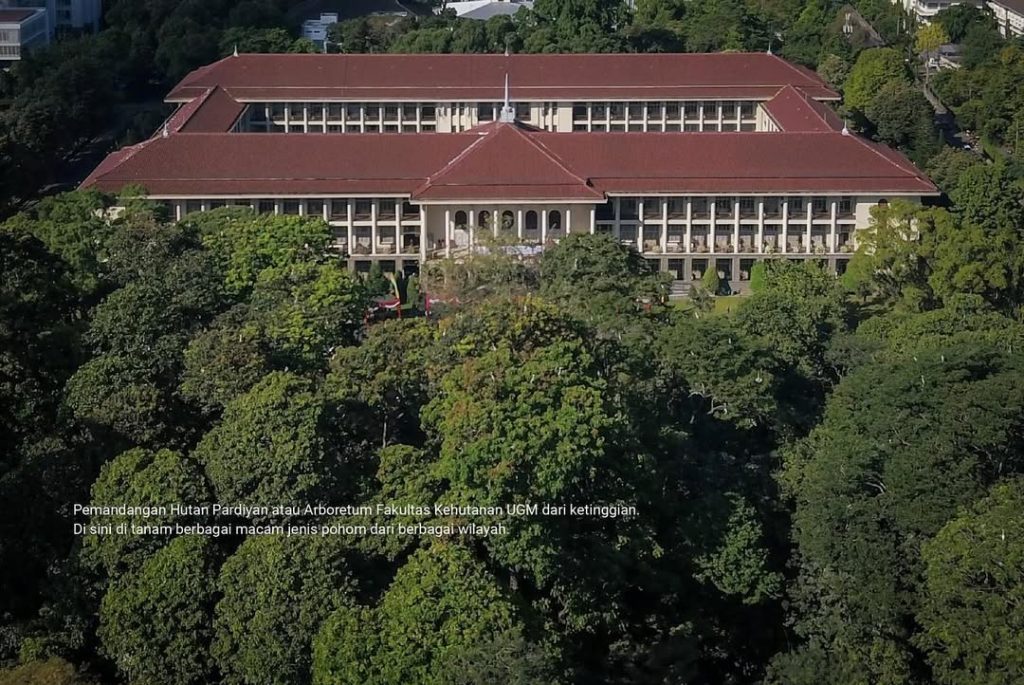
Arboretum Faculty of Forestry UGM
The arboretum, or small forest, was designed in 1971 by the ‘UGM Landscape Plan’ document, which contains the concept of open space arrangement. The philosophical meaning of the existence of the arboretum in the north of the campus Center Building describes a form of ‘service to the people’. From west to east depicts the archipelago, and from Bunderan to Gadjah Mada Forest depicts the journey of a scientist or scholar. The atmosphere is diverse: tunggal ika, then on the left and right resin trees, and so on until finally the bodhi tree, enlightened and Gadjah Mada Forest.
The UGM Campus Bulaksumur Complex has been designed since 1950. Starting in the 1970s, UGM gradually moved from the Keraton and Ngasem campuses to the Bulaksumur Campus. The arrangement of the Bulaksumur campus area is regulated in the 1971 UGM Campus Landscape Plan, which contains the concept of structuring open spaces. One of them is the Arboretum, which is located to the north of the UGM Center Building. The forest is dominated by vegetation, able to create a microclimate compared to the outside climate
In 2023, coinciding with the 59th Anniversary of the Faculty of Forestry, the initiation of planting 13 types of trees aims to conserve and introduce various types of trees that grow on various islands in Indonesia, develop a culture of planting trees for the common good, and support government programs to reduce the impact of climate change.
References: