
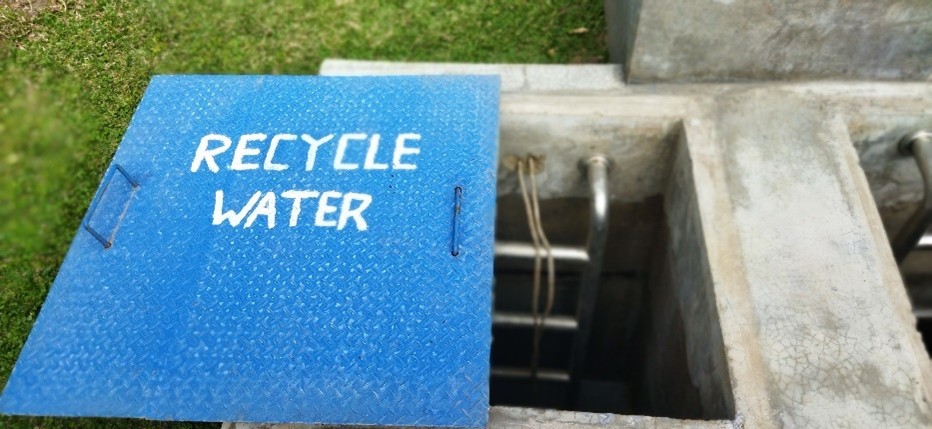
Local government policies of Sleman Regency related to wastewater management, particularly solid waste and sewage (blackwater).
For new buildings, it is recommended to stop constructing deep wells and instead use water supplied by PDAM. UGM also utilizes greywater and rainwater. Greywater is treated and reused for various functions, with the treatment process, end uses, and the rationale for not channeling it into clean water tanks clearly documented. Rainwater is also treated and used as a clean water source, as illustrated in the Rainwater Tank diagram showing its flow into the Ground Tank, demonstrating 100% rainwater utilization in several green buildings at UGM. Faculty-level contributions are presented when available.
Wastewater treatment at UGM.
RSA UGM has implemented its own liquid waste treatment system through a Wastewater Treatment Plant (WWTP) that ensures wastewater quality complies with environmental quality standards in accordance with regulations. The waste management system includes the collection of solid and liquid waste, monitoring of chemical and hazardous material (B3) usage, as well as certification of medical waste treatment equipment based on the required standards. For liquid waste, containers and handling procedures are customized according to chemical and radiological characteristics. Treatment at the RSA UGM WWTP demonstrates the institution’s commitment to environmental sustainability and compliance with the provisions of the Ministry of Environment Regulation KEP-58/MENLH/12/1995 and hospital regulations.
FKG UGM has implemented a systematic wastewater treatment plant (WWTP) management system to handle domestic wastewater, laboratory waste, and stormwater runoff. The WWTP at FKG UGM treats wastewater until it meets environmental standards before disposal, and part of it is even reused for garden irrigation and toilet flushing. The technologies used include bioreactors, membranes, and biofiltration, while solid waste in the form of sludge is processed into organic fertilizer to support the green campus concept.
Wastewater is one of the environmental problems that exist around us. Its presence causes ditches/rivers/streams in the surrounding environment to become dirty and smelly. Wastewater from washing and bathing activities in bathrooms, commonly referred to as “greywater,” is one type of wastewater that appears in residential areas.
At UGM, there are several student dormitories, one of which is Bulaksumur Residence. At the end of 2019, a wastewater treatment system was installed at Bulaksumur Residence as part of a community service program, serving as a pilot application of research developed at the UGM Faculty of Engineering. Currently, this wastewater treatment system continuously treats wastewater from bathrooms before it can be discharged into drains and the Belik River. The result is, of course, much better and cleaner.
Extensive Wastewater Treatment and Recycling Initiatives at UGM
The university has a procedure for managing laboratory waste so as not to endanger the laboratory and the environment. This procedure includes procedures for implementing temporary storage of laboratory waste in each laboratory room, temporary storage of all laboratory waste, and further handling.
Wastewater treatment data in academic hospitals are accounted for through quality testing by accredited laboratories in accordance with applicable regulations.
The Faculty of Dentistry implemented the IPAL system because environmentally friendly technologies such as bioreactors, membrane technology, and biofiltration are used to process wastewater. The Faculty routinely monitors the quality of the wastewater produced by the WWTP to ensure that it complies with applicable environmental standards. Wastewater Treatment at UGM Bulaksumur Residence with Magic Tank Treatment
Wastewater at the Faculty of Dentistry is under strict control. Wastewater processed by the WWTP will be treated to a safe standard for release back into the environment or even recycled for reuse, such as garden watering and toilet flushing.
Implementing the WWTP system at the Faculty faces several challenges, including limited land to construct adequate facilities, variations in waste from various activities on campus, and considerable operational costs. In addition, laboratory waste containing chemicals requires special handling so as not to pollute the disposal system.
Wastewater treatment in Bulaksumur Residence using the Magic Tank Treatment. The Magic Tank Treatment solved environmental problems such as wastewater from washing activities and bathing in the bathroom that appear in residential areas or residences. At the end of 2019, the wastewater treatment system was installed in Bulaksumur Residence in the scheme of Community Service activities as a pilot application of research results developed at the Faculty of Engineering UGM.
Implementation of Water Recycling Program at UGM
The picture below shows the Schematic of The Sewage Treatment Plant (STP) or Biological Treatment Process for Greywater (left) and Schematic of the Water Treatment Process for Greywater (left). Several faculties, including the Faculty of Engineering, have implemented a greywater recycling system.
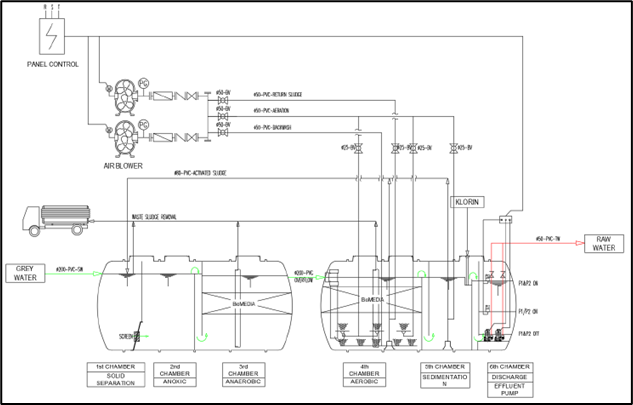
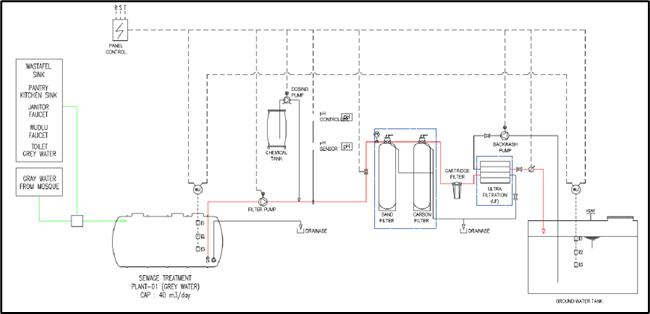
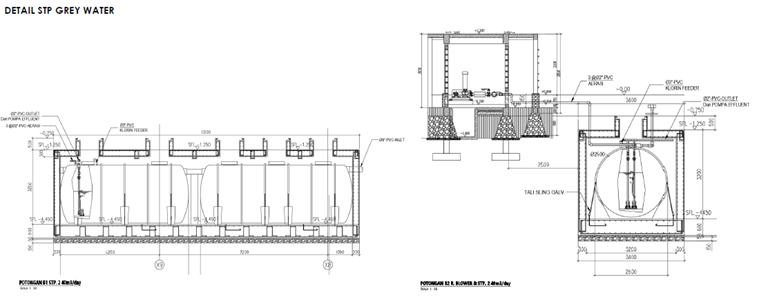
Some pictures above depict the Ground collector tanks at the UGM residence where the greywater resides after finishing the Water Treatment process until it is needed. Also, The greywater recycling system on the rooftop of Kinanti Residen (one of UGM’s student dormitories) is used for flushing toilets and watering gardens. Rainwater harvesting and recycling tanks at the Faculty of Engineering and at UGM Residence, which are part of the campus rainwater harvesting system. Rainwater Harvesting System injected in UGM Learning Centres.
A water recycling program is the process of collecting, treating, and reusing wastewater for various purposes. Through these programs, we can reduce the need for freshwater and minimize environmental impact. Water from sinks, showers, or stormwater is treated and reused for non-potable applications such as irrigation, toilet flushing, or cooling systems.
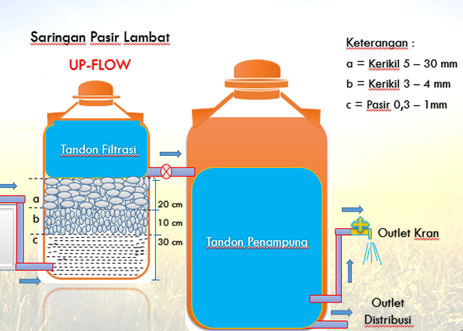
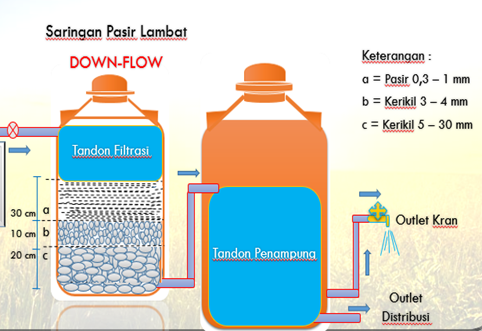
UGM has several ongoing water recycling programs.
Greywater recycling: A system that captures water from dormitory showers and sinks, treating it for reuse in landscape irrigation.
Rainwater harvesting: A system that collects rainwater from rooftops and reuses it for toilet flushing or garden irrigation. UGM uses both rainwater harvesting systems and ducted rainwater harvesting systems.
Other water recycling programs include a recycling system for the University Mosque pond, the Faculty of Animal Science, which uses recycled water from the canteen, and UGM, which uses two water recycling methods: upflow and downflow.
Students provide solutions for wastewater treatment in the community
The UGM PPM Community Service Program team took the initiative to install water filters in several strategic locations in the villages of Kampung Bugis and Senggarang to filter out bauxite particles that pollute the area. The main purpose of installing these filters is to filter out bauxite particles and other contaminants, so that the water used by the community for daily needs such as cooking, drinking, and bathing is cleaner and safer.
The UGM PPM Community Service Program team implemented a project to install water filters at several strategic locations within the villages of Kampung Bugis and Senggarang. This initiative was designed to mitigate water pollution by removing bauxite particles and other contaminants, with the primary objective of ensuring a cleaner and safer water supply for the community’s domestic needs, including cooking, drinking, and bathing.
References: