
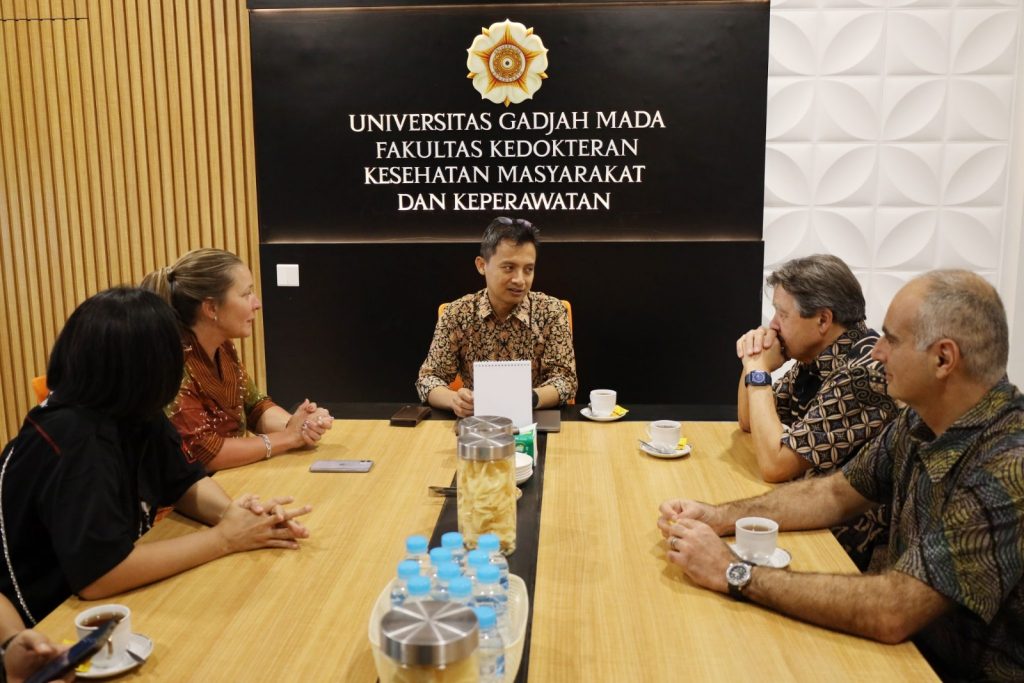
Indonesia has achieved substantial progress in its national development efforts, including in the health sector. Despite these commendable improvements, many challenges in the health sector remain.
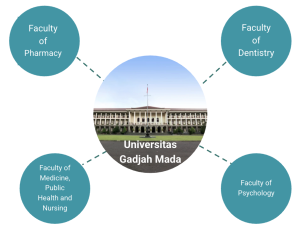
As a university with outstanding health faculties, UGM plays a role in educating and training future health professionals. In 2024, the total number of health profession graduates from UGM reached 2,899 The Faculty of Medicine, Public Health and Nursing contributed the highest number with 1,398 graduates, accounting for 48% of the total. This was followed by the Faculty of Pharmacy with 640 graduates (22%), the Faculty of Veterinary Medicine with 432 (14.9%), and the Faculty of Dentistry with 429 graduates (14.7%).
UGM actively contributes to research in the field of medicine and is a stagnant partner in local, national, and global communities. Not only are we capable of affecting the health and wellbeing of our members and outside communities, UGM can contribute to the knowledge and empowerment in health, and further advance Sustainable Development Goal (SDG) 3 on good health and well-being.
Through the Faculty of Medicine, Public Health and Nursing, UGM has become the founding member of several groundbreaking health networks that strengthen education, research, and healthcare collaboration.
Establishing National and Global Networks
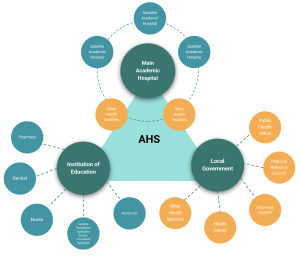
The university pioneered our very own Academic Health System. The concept of an Academic Health System (AHS) was born from the context of developing partnerships between universities and various healthcare providers focusing on research, clinical services, education, and training. UGM had already begun developing the AHS model in Indonesia since 2014. The AHS has now become an organization consisting of hospitals (regardless of ownership), faculties of medicine, one or more other professional health education institutions, research institutions, and forming part of a new model of integrated healthcare services. This model is committed to improving the quality of public health services through health workforce education, high-quality healthcare services, and excellent research.
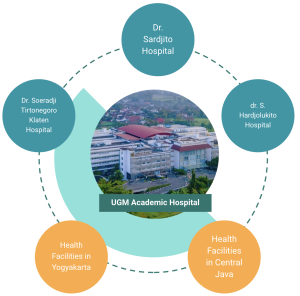
The Faculty of Medicine at UGM collaborated with 3 hospitals to develop the AHS: the Dr. Sardjito General Hospital, the Dr. Soeradji Tirtonegoro Hospital, and the S. Hardjolukito Hospital, while also establishing our very own UGM Academic Hospital to strengthen our teaching hospital network. We have also integrated with other health systems and healthcare service organizations across the Special Region of Yogyakarta (DIY) and Central Java Province.
Besides the AHS, UGM was involved in establishing the Indonesian Clinical Epidemiology and Evidence-Based Medicine (ICE–EBM) Network and the Inter-University Consortium on Global Health (IUCGH). Our university is also a member of the following global health networks:
- The Asian Schools in Public Health (ASPH)
- Toward Unity for Health (TUFH)
- The LINQED Educational Network
- The IDEAL Consortium
- Tropical Education (tropEd) Network for Education in International Health
One of the most prominent international health networks is the HPU.
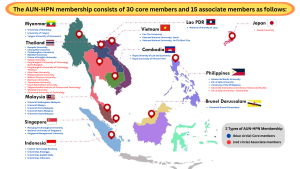
The Health Promoting University (HPU) was initiated by the ASEAN University Network Health Promotion Division (AUN-HPN). UGM, as a member of AUN, delegated representatives who contributed in drafting guidelines for developing HPU across universities in ASEAN between 2015 and 2018. Following its adoption, UGM officially became a Health Promoting University in July 2019 to this day.
There are seven divisions under HPU: health literacy, physical activity, healthy diet, mental health, zero tolerance for drugs, tobacco, and alcohol, zero tolerance for violence, bullying, and harassment, as well as the creation of a healthy, safe, and disability-friendly environment. UGM’s faculties have their own PICs and teams who organize HPU activities with diverse focuses, including promoting physical activity, developing posbindu (integrated health service posts), improving healthy dietary practices, preventing and managing mental health issues, preventing bullying, preventing sexual violence, and many more.
There are still many more local, national, and global health institutions that UGM has collaborated with.
Collaborations with Local Health Institutions
The Academic Health System (AHS) team visited the Dr. Yap Eye Hospital in Yogyakarta to establish partnership and invite the hospital into the AHS network. The establishment of this partnership will open opportunities for collaboration to advance education, research, and community service in the fields of medicine and health.
UGM initiated a partnership with the Yogyakarta Health Polytechnic (Poltekkes Kemenkes Yogyakarta) to build a sustainable health education ecosystem, with a special focus on the subfield of midwifery. In addition to strengthening the capacity of lecturers and students, this partnership is expected to accelerate the achievement of midwifery education quality that is adaptive and relevant to community needs and developments in scientific knowledge.
Collaborations with National Health Institutions
The Faculty of Medicine, Public Health, and Nursing received a visit from the Cilacap Regional General Hospital (RSUD Cilacap). The visit aimed to discuss collaboration in the areas of education, research, community service, and healthcare services, and to discuss the regional AHS scheme for the southwestern part of Central Java.
The Faculty of Dentistry initiated an exploratory collaboration visit with the Bengkayang Regency local government in response to the region’s pressing need for more dental professionals. This visit aimed to identify possible areas of cooperation and develop strategies to help strengthen dental health services in the region.
In 2024, UGM signed an MoU with the Doctor Peduli Foundation (doctorSHARE), a non-profit humanitarian organization focused on providing healthcare services and humanitarian assistance. One of the programs is to provide access to healthcare services in remote areas of Indonesia through Migrant Health and the Flying Doctor initiative.
Collaborations with Global Health Institutions
Dr. Lloyd Williams, Ph.D., an ophthalmologist from the Duke Eye Center in the United States, recently visited UGM. The visit was part of a collaborative agenda to study corneal transplant mentoring between the Faculty of Medicine, Public Health and Nursing, and multiple health institutions; the Dr. Sardjito General Hospital, the Yogyakarta Eye Bank, the Indonesian Ophthalmologists Association (Perdami) Yogyakarta, and the Duke Eye Center.
Another global health institution that UGM has collaborated with is the Netherlands Cancer Institute Antoni van Leeuwenhoek (NKI AVL) on Head and Neck Cancer.
Furthermore, UGM met with the British Council Indonesia in the hopes of opening opportunities for educational grant applications as well as potential collaborations on health-related themes.
References: