
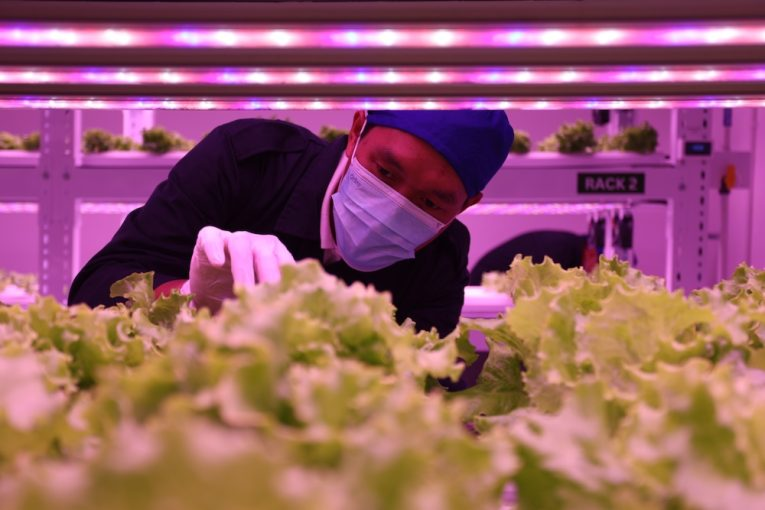
Sources: Smart Agri Plant Factory, Faculty of Agricultural Technology
Universitas Gadjah Mada (UGM) empowers local farmers and food producers by providing access to innovative facilities and technology. Through initiatives like the free-to-use Fab Lab and Agrotechnology Innovation Center, as well as paid services such as food product analysis and lab rentals, UGM bridges academic research with practical solutions. These efforts support sustainable farming practices, enhance productivity, and promote ethical agriculture, demonstrating UGM’s commitment to community developing sustainable farming practices.
Free University Facilities
Access to labs and technology
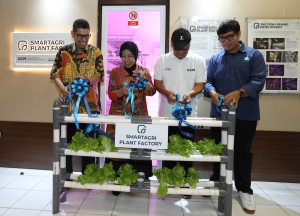
Sources: Smart Agri Plant Factory, Faculty of Agricultural Technology
UGM through the Department of Agricultural Engineering and Biosystems of the Faculty of Agricultural Technology, officially launched the Smart Agri Plant Factory, an innovation designed to address global challenges such as climate change, food security, and efficient land use. By integrating advanced technology with the principles of sustainable agriculture, the Smart Agri Plant Factory aims to transform food production into a more efficient, environmentally friendly, and sustainable system.
In addition to this initiative, UGM also introduced several technological advancements, including drone mapping for topographic analysis and natural resource management, a 6-axis robotic arm for automated harvesting, and autonomous tractor technology that enables high-efficiency and precision land cultivation. Various research-based prototypes developed through collaboration between lecturers and students were also presented. These innovations reflect the strong synergy within DTPB in advancing modern agricultural technology and reaffirm UGM’s commitment to leading agricultural transformation toward innovation, efficiency, and sustainability.
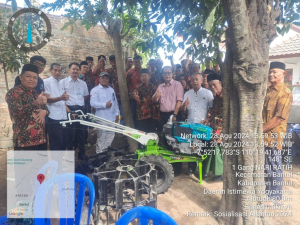
As part of its commitment to applying research and innovation for community benefit, the Faculty of Agricultural Technology at UGM conducted a socialization program on the development and use of agricultural machinery (alsintan). The program, led by lecturers from the Department of Agricultural Engineering and Biosystems and organized in collaboration with the Yogyakarta Special Region (DIY) Agriculture and Food Security Agency, targeted several farmer groups (KT) in Bantul, including KT Wirosutan in Srigading, KT Manunggal Karya in Petung, and KT Tri Manunggal in Geblag.
Held on August 22 and 28, 2024, the sessions aimed to educate farmers on the proper use of agricultural machinery, particularly the Impala hand tractor. Participants received practical training on effective land cultivation techniques, expected to enhance crop productivity and improve operational efficiency. Through this initiative, UGM continues to bridge academic knowledge with real-world agricultural practices, supporting sustainable rural development and empowering local farming communities. Another form of implementation was realized through the Community Service Program (KKN) by creating drip irrigation as an alternative method that was considered more effective for watering or irrigating plants in the Lestari KWT Garden, which included chili and eggplant plants in Malangrejo.
Paid University Facilities
There are many more facilities available to support local food producers, though they are not free.
The Public Service Testing Laboratory assists various stakeholders in providing food product analysis to ensure the safety, quality, and compliance of food with standards.
For those who wish to conduct research but lack the instruments, the lab at the Center for Food and Nutrition Studies can be rented by both UGM-affiliated and external users. The process requires completing a registration form and submitting it to the PSPG administration office. The laboratory operates during regular hours (08:00-16:00), with additional fees for overtime.
For those who need assistance with sample analysis of food or agriculture products, the Center for Food and Nutrition Studies provides these services. Clients can submit samples either by bringing them directly to the PSPG Administration Office or by mailing them along with a cover letter that details the sample’s information. After registration, clients will receive a sample submission form that must be presented when collecting the analysis results.
References:
- Smart Agri Plant Factory, the Faculty of Agricultural Technology
- The Faculty of Agricultural Technologi conducted a socialization program on the development and use of agricultural machinery
- the Community Service Program creating drip irrigation as an alternative method
- Public Service Testing Laboratory of Food and Agricultural Product Technology (TPHP)
- General Laboratory Rental Registration Procedure
- Procedure and List of Analysis Service Fees at PSPG