
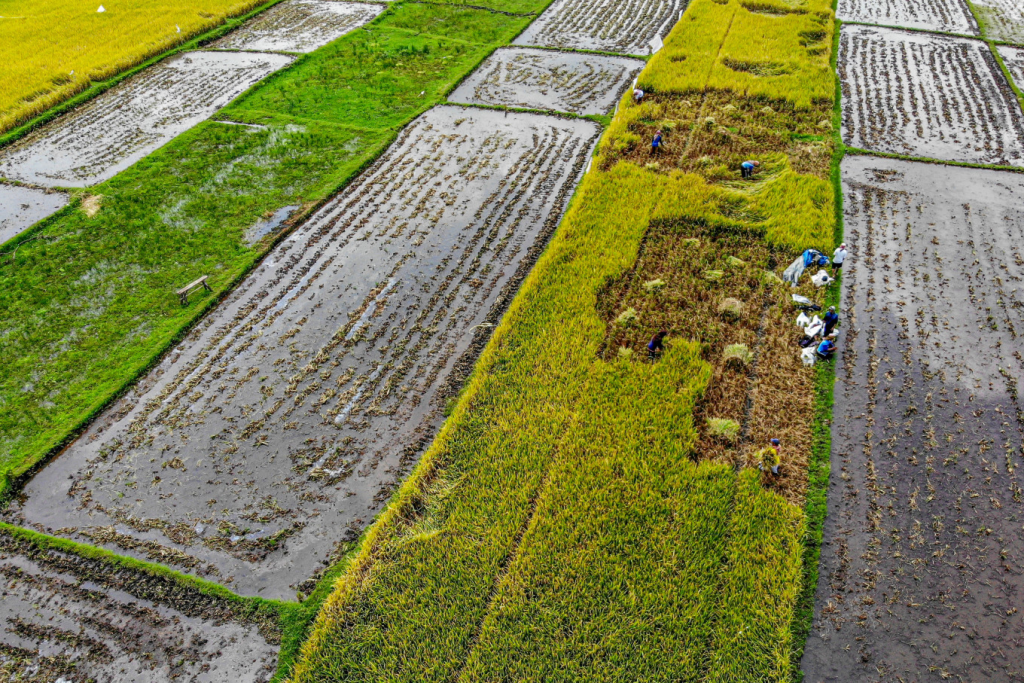
Source: Global Hunger Index (GHI)
Indonesia, a country rich in agricultural resources and home to millions of farmers, continues to face complex challenges in achieving national food security. Despite its vast potential, Indonesia ranks 77th out of 127 countries on the Global Hunger Index (GHI) with a score of 16.9, and 7.2 percent of its population remains undernourished. This paradox underscores the urgent need to transform agricultural capacity into tangible progress in food production and distribution.
UGM is at the forefront of addressing these challenges through inclusive and innovation-driven approaches. By equipping local farmers and food producers with advanced knowledge, practical skills, and sustainable technologies in agriculture and aquaculture, UGM empowers rural communities to strengthen productivity and resilience. These programs, provided free of charge, aim to bridge the gap between farmers and markets while promoting sustainability, improving livelihoods, and supporting Indonesia’s long-term goal of food sovereignty and zero hunger by 2030.
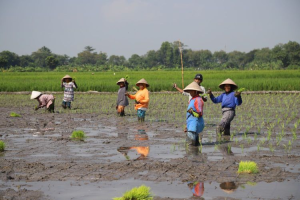
Sources: Planting Gamagora rice to support food security and sustainable agriculture.
One of the main concerns to national food security in Indonesia is the limited rice supply. Rice is the primary source of carbohydrates for Indonesians, with a consumption rate reaching 130 kg per year. Climate change poses a major threat to rice productivity, leading to an increase in pest populations, irregular rainfall, and droughts that result in crop failures. UGM takes pride in being one of the nation’s leading academic institutions in advancing food security research through the development of Gadjah Mada Gogo Rancah (Gamagora) rice, an innovative rice variety that has been continuously developed since 2006.
The variety is currently being promoted and tested in multiple regions—in the provinces of Bengkulu, West Java, Central Java, East Java, and West Nusa Tenggara—to reach a wider community. Gamagora rice was specifically developed to address challenges related to climate change. It offers several advantages compared to conventional rice varieties, including the ability to thrive in dry conditions, higher pest resistance, and reduced need for fertilizer and water. By 2024, Gamagora has reached a productivity rate exceeding 10 tons per hectare.
In 2023, UGM conducted a number of feasibility trials on a number of potential varieties. There were 25-30 promising varieties that entered the preliminary testing stage. Then, 12 promising varieties entered the advanced preliminary testing stage. From this series of tests, 10 promising varieties were selected. The final testing phase is called the final variety release phase or multi-location testing. From the 10 selected varieties, 1 variety was recognized by the government as having high productivity and was deemed suitable for release as a national superior variety. This variety is known as Gamagora 7 and received a release decree from the Ministry of Agriculture on March 28, 2023.
The Gamagora variety is currently under the pre-adoption phase. The introduction of Gamagora rice to the public is carried out through two strategic stages. First, the seed cultivation scale-up stage, which aims to expand the use of Gamagora 7 seeds in various regions. Second, the rice cultivation stage using smart fertilizers, which are also the result of UGM innovation. Both innovations receive full support from the Asian Development Bank’s PRIME STeP program 2023-2024, which accelerates the process of commercializing agricultural innovations into the market. Gamagora is also introduced to local farmers near UGM through the Agrifest 2024.
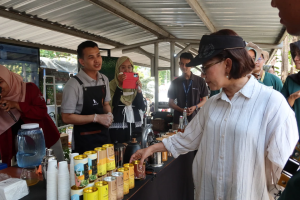
Sources: Agrifest 2024 featured a rice-based culinary competition using Gamagora rice
Agrifest is an annual event held by UGM’s Agro-technology Innovation Center (PIAT) that highlights the role of technological adaptation in advancing agriculture through a series of activities, including agrotechnology talk shows, innovation exhibitions of programs and products at PIAT, and demonstrations. These initiatives aim to expand knowledge, foster creativity, and enhance access to agricultural technology for both farmers and the wider public. In 2024, the event featured a Rice Innovation Competition using Gamagora rice, to demonstrate Gamagora’s versatility for diverse dishes.
The Gamagora 7 variety has advantages in terms of productivity with a higher yield (>10 tons/ha) compared to other rice varieties (8.0 tons/ha), is 20% more productive, and has a shorter production period (<104 days), thereby increasing the planting cycle. The discovery of the Gamagora 7 rice variety is expected to address the threat of famine caused by climate change, land constraints, and limited water resources for agriculture. This is clear evidence of UGM’s contribution to SDG 2 on Zero Hunger.
The Gamagora 7 rice variety, the result of research by the UGM Agro-technology Innovation Center, is currently undergoing market testing. This rice variety is being trialed on rice fields in a number of areas at 9 locations in Pati, Wonogiri, Banyumas, Blora, Cepu, and Ngawi in East Java.
The development of Gamagora has involved a number of collaborations in several local and regional areas. For example, in Ngawi Regency, UGM has partners in collaboration with the local regency government, the Food Security Agency, PT Agri Sparta, PT Wahana Inti Makmur Tbk, and the Bina Sparta Farmer Group.
Meanwhile, collaboration through community service has been successfully implemented on Enggano Island, using Gamagora as a food security solution on Indonesia’s outermost island. This collaboration also involves other partners such as Universitas Bengkulu.
In response to the challenge of national food security, UGM has commercialized the Gamagora 7 rice variety into a premium rice product called Presokazi. The Presokazi rice innovation is aimed at addressing nutritional deficiencies, particularly iron (Fe) and zinc (Zn) in children and pregnant women, which cause stunted growth and development in children. Rice, as the staple food of the Indonesian people, is a promising option because it is affordable and highly accessible. Presokazi rice is produced from the cultivation of the Gamagora 7 rice variety using Super Smart Fertilizer (SSF), which is also an innovation from PIAT UGM.
In 2024, the Gamagora rice cultivation team successfully planted the new Gamagora rice variety for the first time in Karangwungu Klaten regency. Researchers from UGM worked hand-in-hand with the Klaten State Logistics Agency (Bulog), the Agri Sparta startup, the Klaten Food Security and Agriculture Agency (DKPP), and the Karangwungu Farmers Group (Gapoktan). The development of Gamagora rice aims to address the decline in national rice production caused by climate change phenomena such as El Nino and La Nina, as well as the conversion of rice fields to non-agricultural land, which has reached approximately 96,512 hectares annually.
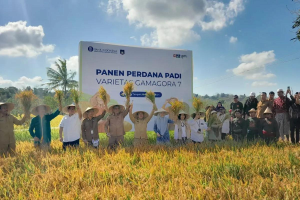
Sources: Gamagora in Central Lombok
In 2024, the Gamagora rice was also successfully harvested for the first time in Central Lombok. UGM collaborated with Bank Indonesia’s West Nusa Tenggara branch. Gamagora has also been successfully cultivated in the Special Region of Yogyakarta, Central Java, East Java, West Java, Bali, and West Nusa Tenggara.
References:
- Global Hunger Index (GHI)
- Agrifest 2024 featured a rice-based culinary competition using Gamagora rice
- Gamagora rice cultivation team successfully planted Gamagora rice variety in Klaten
- Gamagora in Central Lombok
- Feasibility trials on a number of promising varieties
- Gamagora 7 received a release decree from the Ministry of Agriculture on March 28, 2023
- The Gamagora product is in the pre-adoption phase
- Gamagora is currently undergoing market testing
- Collaboration with Ngawi Regency
- Gamagora implemented on Enggano Island
- Collaboration with Universitas Bengkulu
- UGM premium rice product called Presokazi