Day: September 3, 2021

  • UGM Students Create Educational Game Go-Taru

    UGM Students Create Educational Game Go-Taru

    Four UGM students presented the Go-Taru educational game. Go-Taru is an educational board game for animal and environmental conservation in collaboration with applications and Augmented Reality (AR). This game was released by the UGM Student Creativity Program team, Muhammad Farel Rafifawwas from the Faculty of Engineering (FT), Kirana Maharani from the Faculty of Economics and Business (FEB), Aditya Ramadhan from the Faculty of Engineering (FT), and Muhammad Ridwan from the Faculty of Engineering (FT).

    Go-Taru is a campaign effort to care for animals and the environment. Unlike ordinary board games, Go-Taru provides a touch of technology as a way to keep up as technology advances. This educational game consists of several components, a board game with an adventure map concept in the form of puzzles, game cards, character pieces, and the Go-Taru application. Go-Taru educational game has four types of cards: animal cards, trash cards, knowledge cards, and opportunity cards. “Each card represents educational material about animals and the environment,” said Muhammad Farel Rafifawwas as team leader, Friday (3/9).

    According to Farel, the idea of ​​making Go-Taru was motivated by the team’s concern about the phenomenon of animal extinction due to environmental damage. Therefore, environmental education needs to be instilled from an early age, such as through interactive learning media that is more fun than the usual learning media. While the name Go-Taru itself comes from the words “Go” and “Kalpataru” with the hope that this game will be able to invite people to care more about the environment. “Go-Taru is presented as an educational medium that targets teaching communities at UGM, Yogyakarta, and Indonesia. We also work with environmental institutions or communities to jointly campaign for the importance of environmental education,” he said

    In addition, this educational game media can be an interactive learning solution and an inventory of learning media in communities and schools. “Currently, Go-Taru is available on the marketplace and Instagram @gotaru.boardgame,” he concluded.

    Source: https://www.ugm.ac.id/id/berita/21628-mahasiswa-ugm-bikin-permainan-edukatif-go-taru


  • UGM Masters Program in Communication Sciences Holds Graduate Student Symposium on Communication Science 2021

    UGM Masters Program in Communication Sciences Holds Graduate Student Symposium on Communication Science 2021

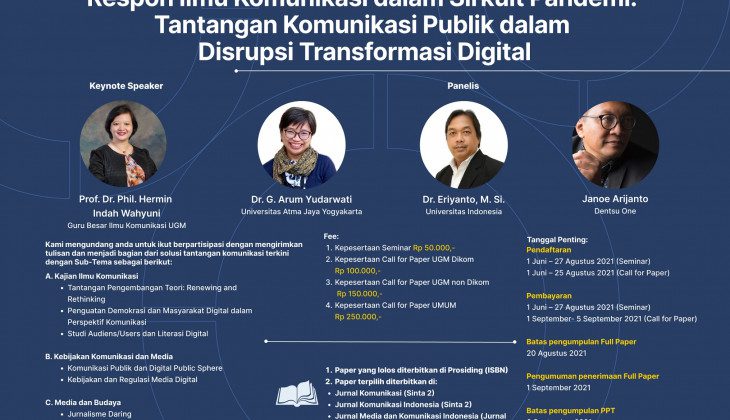
    To have a dialogue and find solutions to public communication problems, the student team of the Masters (S2) in UGM Communication Science held a “Communication Science Postgraduate Student Symposium”. Carrying the theme “Communication Response in a Pandemic Circuit: Challenges of Public Communication in Disrupting Digital Transformation,” this forum facilitates postgraduate students and alumni to exchange ideas in solving various public communication problems.

    The symposium will be held online on 9-10 September 2021, presenting Prof. Hermin Indah Wahyuni ​​as Keynote Speaker, and three panelists, Dr. G. Arum Yudarwati from Atma Jaya University who will talk about “Digital Public Communication Strategies in the Context of the (Post) Covid 19 Pandemic,” Dr. Eriyanto who will discuss the “Direction of the Development of Communication Studies and Contributions in Responding to the Crisis of Public Communication”, and Janoe Arijanto who will explain “Changes in the Media Landscape and Challenges of Public Communication: Professional Perspectives”.

    This event was supported by the journal manager from the Jurnal Komunikasi Indonesia by the Department of Communication, Universitas Indonesia, Jurnal Komunikasi by the Department of Communication Universitas Islam Indonesia, and Jurnal Media dan Komunikasi Indonesia by the Department of Communication Studies UGM. It is estimated that 150 participants are involved in this event.

    Rahayu, Head of the Master of Communication Studies Program, UGM FISIPOL, stated that the purpose of this symposium is to provide a forum for postgraduate students and alumni to be creative and find solutions for public communication problems. According to her, digital transformation and the current Covid-19 pandemic have changed the communication environment dramatically.

    Changes in digital technology are not only related to the emergence of various types of digital media platforms but also the interactivity and relationships of increasingly broad and varied patterns of social relations. Changes also show in the expansion and intensification of digital media use in various sectors as the impact of the Large-Scale Social Restrictions (PSBB).

    “This change in the communication environment brings a big challenge to the management of public communication by both public and private organizations,” she said at the UGM Faculty of Social and Political Sciences on Friday (3/9).

    According to her, public communication is an element in determining the quality of social, political and economic life. In a changing communication environment, communication can no longer be managed with conventional methods, and innovative ways are needed with new approaches to achieve the expected goals.

    The concept of public communication differ than propaganda and public speaking or the technique of delivering public persuasive messages. Public communication demands a comprehensive understanding of the public interest, public information, digital media, and the interrelationships between organizations and the public.

    “Public communication also faces problems related to the circulation of misinformation as trusted information and information from official sources,” she explained.

    For this reason, said Rahayu, this symposium will discuss a number of important questions, including the contribution of communication science in managing public communications, especially facing digital disruption and the current pandemic situation. How do communication sciences and scientists respond to social, cultural and technological changes or shifts? How do we anticipate the challenges and risks in public communication that arise from digital transformation, the pandemic, and post-pandemic?

    “After the symposium, we hope that a number of solutions that are relevant to public communication problems will emerge,” said Rahayu.

    Source: https://ugm.ac.id/id/berita/21632-prodi-magister-ilkom-ugm-gelar-graduate-student-symposium-on-communication-science-2021