Month: December 2019

  • Minister of Research and Technology Reviews Gama Cattle’s Cage Facilities

    Minister of Research and Technology Reviews Gama Cattle’s Cage Facilities

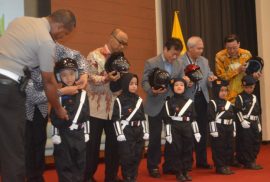
    Minister of Research and Technology, Prof. Bambang Permadi Soemantri Brodjonegoro, Ph.D., visited the Livestock Workshop and Center of Excellence at the Faculty of Animal Science at Universitas Gadjah Mada (UGM) in Jambakan village, Bayat District, Klaten Regency, Central Java on Wednesday (12/18). The visit was done to review the cattle breeding cage facilities from the collaboration of UGM and PT Widodo Makmur Perkasa (WMP).

    Dean of the Faculty of Animal Science UGM, Prof. Dr. Ir. Ali Agus, DAA, DEA, IPU, Asean.Eng., in a press release sent on Friday (12/27) said that a cattle breeding cage with complete industry-standard facilities was built in the context of joint research to improve the quality of livestock, which is experiencing malnutrition and poor growth. “We have worked together for 20 years,” he said.

    This cattle repair shop, according to Ali Agus, uses a multifunctional feed additive formula that contains minerals, immunomodulatory vitamins and herbal extracts. In this research Gama Cattle (also known as “Lembu Gama”).

    “Gama Cattle is a composite breed of 3 cattle types: Brahman cattle which are adaptive for the tropics, Belgian Blue cattle that are large and have double muscles, and Wagyu cattle whose meat is tender and juicy,” he said.

    He said that Gama Cattle had reached the triple composite stage with a population of 28. According to him, his oldest male Belgian Blue cross could weigh almost 1 ton at 36 months. While at the age of 20 months it weighs 550 kg, some are almost 600 kg. “The male, 31 months old reaches 730 kg, or twice the weight of a local cow,” he explained.

    According to Ali Agus, Minister Bambang Brodjonegoro supported that the cattle workshop also partnered with farmers and private partners to overcome the growth problems in livestock.

    On the occasion, said Ali Agus, Ministry of Research and Technology plans to assist in funding research on the development of the composite Gama Cattle, through the development of F2 and F3 of the composite. However, the Minister of Research and Technology requested that UGM not only cooperates with the WMP, but could also involve other private actors. Thus, beef production can be greater, reducing imports and accelerating the achievement of beef self-sufficiency.

    Sources: https://ugm.ac.id/id/berita/18902-menristek-tinjau-kandang-budi-daya-lembu-gama


  • Preventing Violence, UGM Professor Encourages Schools to be More Child-Friendly

    Preventing Violence, UGM Professor Encourages Schools to be More Child-Friendly

    Cases of violence, poisoning, accidents, easily collapsed buildings in schools are still a common concern among stakeholders and education managers in DIY. To reduce the number of violence and accidents in schools, Professor of Universitas Gadjah Mada, Prof. Dr. Suratman, M.Sc., suggested that schools launch a child-friendly school program. “The goal of child-friendly schools is not to make new school buildings, but it is a new paradigm in educating and teaching students to create a new generation that is resilient and free from violence,” Suratman said in a press release sent on Monday (12/23).

    According to him, child-friendly schools foster teacher’s sensitivity in education units to meet and protect students. The reason is because the basic concepts of culture-based education are humanist, religious, and multicultural. “Schools must be pro-gender and pro-child. Therefore culture must be included as an educational content,” he said.

    The child-friendly school movement was launched last Saturday by involving several high school principals in the Yogyakarta Province and stakeholders through the declaration of the WSD-SDGs program in schools. Through this declaration, school managers in Yogyakarta are expected to be able to run child-friendly school programs through their respective willingness and commitment. The school also took the initiative from the education unit to prevent children from food poisoning and an unhealthy environment, accidents at schools caused by infrastructure or natural disasters. “We also hope to prevent children from smoking and using drugs and create better, friendlier relationships between school members,” he said.

    This child-friendly school program will facilitate child monitoring in school, making it easy to achieve educational goals, creating a green and orderly environment. Indicators of this success are shown by how children become more comfortable in school and accustomed to positive habituation. “The principles of child-friendly schools are non-discrimination, the best interests of children, survival and development, respect for the views of children,” he said.

    The launching of this child-friendly school program in Yogyakarta will later support the vision of the development of education in Yogyakarta in 2025 to become the Leading Center of Culture-Based Education in Southeast Asia. Therefore, the management and implementation of Yogyakarta’s education is based on the National Education System by upholding the values ​​of the nation’s culture.

    Source: https://ugm.ac.id/id/berita/18894-cegah-kekerasan-guru-besar-ugm-dorong-sekolah-lebih-ramah-anak


  • UGM – Foreign Ministry Gives Scholarship to Students from Non-Aligned Movement & South South Countries

    UGM – Foreign Ministry Gives Scholarship to Students from Non-Aligned Movement & South South Countries

    Universitas Gadjah Mada (UGM) and Foreign Affairs Ministry have agreed to give scholarship to students from member countries of Non-Aligned Movement and developing countries in Asia and Africa. This is expected to strengthen diplomatic ties of Indonesia in international cooperation.

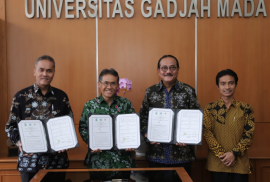
    “We believe this cooperation will benefit Indonesia in building South-South cooperation where UGM can be a partner,” said Rector of UGM, Prof. Ir. Panut Mulyono, M.Eng., D.Eng., Ph.D., IPU, ASEAN Eng., after the signing of the cooperation agreement in the conference room of UGM on Thursday (26/12).

    According to the Rector, through this cooperation UGM would invite the best young people from Non-Aligned Movement and South to study at UGM. “These best young people from our South-South partner countries will become our ambassadors in their countries after graduating,” he said.

    Rector said the same scholarship program would also be given by UGM to the young people from Southeast Asia. “Currently, UGM has given as many as 16 scholarships, now the figure is increased with a full scholarship from UGM,” he said.

    Several countries such as Namibia and Palestine, said the Rector, had asked UGM to increase the quota for their students to get the scholarships from UGM.

    Diplomat Diar Nurbintoro said the Indonesia’s diplomacy cooperation with the South was not only in the form of physical development but also human resource development. “Our cooperation is not just to develop the infrastructure in many areas, but also the human resources,” he said.

    Director of Non-Aligned Movement Center, Ronny Prasetyo Yuliantoro, said the cooperation was expected to enhance Indonesia’s diplomacy with other developing countries in applying its free and active foreign policy. “This cooperation will bring good results not just to Indonesia but also member countries of Non-Aligned Movement and developing countries that need Indonesia’s role in capacity development,” he said.

    Source: https://ugm.ac.id/id/berita/18900-ugm-dan-kemenlu-beri-beasiswa-untuk-pemuda-dari-negara-anggota-gerakan-non-blok


  • Faculty of Biology UGM Holds Research Day 2019

    Faculty of Biology UGM Holds Research Day 2019

    The Faculty of Biology UGM held 2019 Research Day on Friday (12/20). Through this event, 57 collaborative research findings from lecturers and students of the Faculty of Biology UGM were disseminated and evaluated in the form of posters. This event also included book exhibition and videos of the research results and community service conducted by the staff.

    A public lecture was also held on the topic “Marine Resources”. This lecture is a dissemination of doctoral research results from the late Ratih Aryasari, S.Sc., M.Sc., presented by Juswono Budi Setiawan, S.Sc., M.Sc., (UGM Center for Marine Resources and Technology Studies), Dr.rer.nat. Edwin Setiawan, S.Si., M.Sc. (Biology Institut Teknologi Sepuluh Nopember), Dr.rer.nat. Yosi Bayu Murti (Pharmacy UGM), and Bayu Rahmad (Program Manager of Coastal and Small Islands, KEHATI Foundation).

    Lisna Hidayati, S.Si., M.Biotech., as one of the event organizers, stated that the public lecture was held as a tribute to the Faculty of Biology UGM to the deceased. She was a colleague of Lisna as a fellow lecturer at the Faculty of Biology UGM and did her doctoral program at Universität Göttingen, Germany.

    “She was actually close to completing the research. Even one month before she died she had asked to publish her research in one of the faculty events. At that time I, who was also a committee member, already held her publication manuscript. Finally, when this event was planned, we were thinking of doing this public lecture,” she said.

    Lisna hoped that in the future this kind of event can be held again. Thus, the results of research from UGM and in particular the Faculty of biology could be shared to the public. “That’s because this event is dedicated to students and lecturers. For students, it is a place to look for ideas and research supervisors. For lecturers, this event is a place to find research partners with similar interests,” she concluded.

    Source: https://www.ugm.ac.id/id/berita/18896-fakultas-biologi-ugm-gelar-research-day-2019


  • UGM Alumni Hold Installation Art Exhibition

    UGM Alumni Hold Installation Art Exhibition

    A total of 14 artworks and creations from UGM alumni were exhibited at the Week of Art, Architecture + Urbanism (WA+U) event on December 14-21 at the Hardjasoemantri Cultural Center (PKKH) UGM. The exhibition which was held to enliven the 14th Anniversary of UGM displayed various works of alumni who have been pursuing their respective fields.

    One of the artworks was a batik guitar by Haryo Sasongko, a graduate of UGM Architecture in 1968. This G&B brand guitar is eccentric because of the batik ornaments on it. Sasongko said that he had been playing bass guitar since 1964. However, in 1994 he had the idea of ​​making a batik guitar until finally in 2016 he received an award for it from the Indonesian Records Museum.

    The works of Kenzo and Nita displayed batik patterns as a cultural heritage. Batik is used not only as a fashion, but also as a decoration of guest rooms, bedrooms and utensils. However, what made it unique is it uses natural dyes called batik natural indigo.

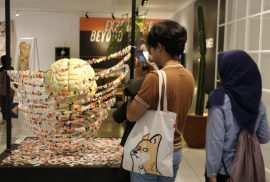
    Other artworks included anatomy of the human brain surrounded by thousands of cellphone SIM cards hanging on a thread. Around the miniature of the brain, SIM cards from used cellphones were seen scattered around. The work explains how the memory of the human brain cannot be separated from communicating via cellphones and accessing various information data through the internet.

    The coordinator of the WA+U exhibition, Bernard ‘Ben’ Sihombing, said most of the artworks exhibited in this event were created by graduates of Architecture, Faculty of Engineering, UGM. According to him, the various installation artworks resulted from creative ideas that are academic, popular and can be enjoyed by millennial generations. “Their works are the result of collaboration between fellow alumni, the community and entrepreneurs,” he said.

    He said of the 14 works divided into two groups, four artworks of the most senior alumni from the 1960s to the 1970s were exhibited on the second floor, while those of alumni who graduated in the 2000s were exhibited on the lower floor. “There were around 30 works that entered. After we curated, 14 works were chosen,” he said.

    There were two works of alumni living in Germany and Japan. They displayed art in the form of applications and robots related to construction. “We display their work through a multimedia screen,” he said.

    Although this is the first time, Ben hoped that this kind of exhibition would be regularly held every year with different themes. He said this year’s exhibition tends to cover themes on art, architecture and urban design.

    Source: https://ugm.ac.id/id/berita/18889-alumni-ugm-gelar-pameran-karya-seni-instalasi


  • Discrimination against HIV AIDS Survivors

    Discrimination against HIV AIDS Survivors

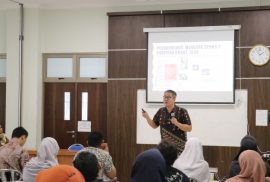
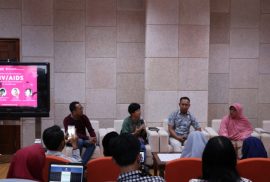
    HIV/AIDS survivors are often discriminated not only by the community but also by health workers who are supposed to serve and treat them regardless of their background. Discrimination by health workers is thought to be due to stigma and lack of education. The topic was raised in the Discussion on Discrimination and Stigma against People Living with HIV/AIDS (PLWHA) in Health Services in Yogyakarta on Friday (1/12) at the Faculty of Medicine, Public Health and Nursing (FKKMK).

    Ragil Sukoyo from the HIV/AIDS Volunteer Group said he often works with HIV/AIDS patients who are discriminated against by medical personnel. During examination, medical personnel seem reluctant and afraid of being contracted so the service is not optimal. “Medical staffs do not want to hold their patients just to check blood pressure, there is a concern among medical staff when examining HIV patients,” he said.

    Several times he also got patients who were lectured on religion by medical officers while all they wanted was to seek treatment. “Health workers do have various personality characteristics,” he said.

    According to him, this discrimination happens not only in health services. The community also still considers transvestites, gay and sex worker groups to be at risk of HIV/AIDS infection.

    The same experience was told by March Setya Kurniawan from the Vesta Indonesia Foundation. He works with patients who were refused by the Public Health Centers. “Officers answered that they were not ready to serve HIV patients as there was no special room for HIV patients. But we don’t need to be specialized and distinguished, we just need to be served,” he said.

    Setya Kurniawan also once did a testimony by going directly to a hospital in Yogyakarta. He said he had a fever after taking HIV medicine, and then the administrative officers and nurses discriminated him. Although eventually served, he got good treatment from the doctors. “Medical staffs are also supposed to be informed about HIV services,” he explained.

    HIV/AIDS researcher from FKKMK UGM, dr. Yanri Wijayanti Subronto, Ph.D., Sp.PD., said that health workers should not discriminate against HIV/AIDS patients. Good service should be given regardless of the patient’s background. “Health services already have standards from director to security guard level when serving patients,” he said.

    Yanri said discrimination against PLWHA still happens because of the negative stigma attached to them. Not only sufferers who tested positive for HIV/AIDS, but also gay people, transvestites and commercial sex workers are discriminated. “The HIV stigma is strong enough especially if it is confined to religion, there should be no stigma if the approach is humanitarian,” she said.

    Mami Vinolia Wakidjo, administrator of the DIY Waria Large Family, said she was one of the transvestites who received good treatment by her neighbors in the Gowongan area, Yogyakarta. In fact, she is active in Family Welfare Movement (PKK) activities in her residence. “I am often invited to give a talk for mothers, where I also include topics on transvestites,” she said.

    Source: https://ugm.ac.id/id/berita/18886-penyintas-hiv-aids-sering-mendapat-perlakuan-diskriminatif


  • ICRS Research

    ICRS Research

    Handling vulnerable people, saving the environment, strengthening local culture and national sovereignty through interdisciplinary research

    OUR RESEARCH AIMS to develop knowledge, strengthen civil society advocacy, and consider public policy in the field of religion. To achieve this, we have established cooperation with various stakeholders to conduct research in the following areas:

    Religion and politics

    The relationship between state, society and religion has become one of the world’s central issues recently, including in Indonesia. Religion not only influences political expression and social relationships in society but is also influenced by the socio-political context in which it occurs. After intensive research, our team developed the theory and practice of “civic pluralism” in the context of Indonesian society. Several works we have published are:

    • Merangkul Penghayat Kepercayaan melalui Advokasi Inklusi Sosial (July 2019)

    This report discusses advocacy practices—which involve perspectives, methods, and strategies—for native-faith followers. In addition, this report describes ways to advocate social inclusion.

    • Pemilu dan Jalan Non-Kekerasan Para Jihadis (April 2019)

    So far, terrorism and extremism have often been looked through the lens of security studies. This report, published in collaboration with PUSAD Paramadina, notes experiences in Poso and Bima, and shows that the 2019 elections succeeded in facilitating a non-violent channel for political aspirations of former terrorists.

    • Kerukunan dan Penodaan Agama: Alternatif Penanganan Masalah (December 2017)

    Some argue that legislation to prevent “religious blasphemy” is necessary to maintain religious harmony. This report shows that the impact of legislation does not in fact support harmony, but rather there are other ways to prevent “religious blasphemy”.

    • Serial Report on Religious Life: Local Politics and Religious Conflict: Elections and Political Opportunity

    • Structure in Religious Conflict in Sampang, Bekasi and Kupang

    • Managing Diversity and Religious Freedom: History, Theory and Advocacy (First book)

    • Managing Diversity and Religious Freedom: Reflection for some approaches to advocacy (second book)

    • Civic Pluralism: A New Direction of Political Diversity in Indonesia

    ​Interfaith relations

    With the development of transportation technology and intensified migration, the world has become complex. Indonesia is no exception. Consequently, dialogue and cooperation among religions continue to deepen. However, interreligious relations are also marked by tension, conflict and violence between religious communities. Adopting a perspective of religious freedom and harmony, we carry out research in this field, among which have been published:

    • Aspiration for Modernity and Prosperity: Symbols and Sources Behind Pentecostal/ Charismatic Growth in Indonesia

    • Papua’s Hidden Pearl: The Potential of Local Wisdom for Reconciliation in Papua

    • Religious Pluralism and Religious Freedom: Religions, Society, and The State in Dialogue

    • Crescent in Bali: Traces of Islam in Kusamba, Bali

    • Badingsanak Banjar-Dayak: Religious Identity and the Economics of Ethnicity in South Kalimantan

    • Church Controversy in Jakarta

    • Interreligious Dialogue: Ideas and Practice in Indonesia

    Religion, culture, and nature

    In recent decades scholars have been compelled to look back on the relationship between religion and culture, including local beliefs. Moreover, with environmental crises and the massive natural disasters, discussions about religion, local culture and the environment (nature) have become increasingly important. The colonial paradigm, a perspective usually adopted by the “world” religions, needs to be reviewed in a process of emancipation for more equal inter-group relations. Our team rearranges the relationship between religion, culture and nature by conducting research on topics such as religion and local culture, local religions, religion and natural disasters, and religion and the environment. Our published works include:

    • On the Connections Between Religion and Disaster: A Literature Review

    • Religion, Culture and Disaster: An Integrative Study of Science, Religion and Culture (first book)

    • Disaster and Religion Series: Local Community Response on Disaster: An Integrative Study of Science, Religion and Culture (second book)

    • Disaster and Religion Series: The Construction of Disaster Resilient Communities: An Integrative Study of Science, Religion and Culture (third book)

  • Human Dignity Project

    Human Dignity Project

    A regional platform for mutual learning, action and advocacy, working toward achieving dignity, justice and sustainability in Southeast Asian (SEA) society.

    Civic Engagement 4.0: Dignity, justice, sustainability

    WITH THE RISE of technological advancement, Indonesia has been facing a value crisis. Radicalism and intolerance manifest themselves in this phenomenon. Human dignity as the core of religious teachings has shifted into a shallow religious understanding. Religious education has become reductive and polarized the society. Meanwhile, falsehood and hate speech are being normalized on social media, cutting across every part of social life. These conditions endanger both social mindset and the national unity. To address these issues, we initiated a project on enhancing human dignity by reviewing religious education in Indonesia.

     “Civic Engagement 4.0: Dignity-Justice-Sustainability” facilitated discussions for participants from different sectors to achieve dignity, justice, and sustainability in Southeast Asia in the era of urbanization and technological advancement. Justice and dignity need to be championed as core values in pursuit of sustainability. This is because sustainability cannot be achieved in economic terms alone; environmental, socio-cultural, and spiritual aspects are equally essential. In a sustainable society, everyone should enjoy life while being respected as humans.

    This project began with “2019 International Forum in Solo”, Indonesia on August 20 to 23, 2019 which comprised of an opening ceremony, the Public Forum, the Mayors’ Symposium, an art exhibition, and thematic field visits. Around 250 participants were involved, including academics and students, NGO activists, government officials, and policymakers from Indonesia, Thailand, Japan, Australia, Canada, and the United States. This event was made possible through collaboration between ICRS, KotaKita (Solo), and Chulangkorn University (Thailand).

    Over 50 percent of the world’s population live in urban spaces; this figure is expected to grow to more than 60 percent by 2030. The benefits and challenges of city life—poverty, inequality, climate-related disasters, and migration—are hyper-realized in urban areas. This must be confronted with innovative and practical solutions. Our project invited progressive city mayors from Indonesia, Malaysia, Thailand, the Philippines, and Cambodia to present their efforts in achieving a dignified, just, and sustainable society. At this event, participants from the civil society exchanged with the mayors directly to build upon common approaches and plan follow-up actions.

    This event was part of our community service program series on “Co-Designing Sustainable, Just and Smart Urban Living through ICRS Education, Civic Engagement and Policy Advocacy”, a two year program (2019-2020) featuring a series of the following events: National Seminar (April 2019), Appropriate Innovative Product Competition (May 2019), an FGD with Teachers and High School Students (July 2019 and October 2019), Civic Engagement 4.0 International Forum (August 2019), Talk Radio (April and August 2019), Talk Shows at High School and Islamic Boarding School (November & Desember 2019), International Seminar and Public Campaign in Yogyakarta and Mataram (2020).

    Overall, the goal of this program is to jointly design strategies and recommendations for government and public policymakers to produce policies that will shape just, intelligent and sustainable cities and communities. We intend to create academic papers, books, digital application training modules, and policy recommendations. To achieve this, we work together with high schools, universities, community organizations, faith communities, central and local governments, and policymakers.

    Plans for 2020: Resolving religious intolerance

    “Combatting intolerance, negative stereotyping and stigmatization of, and discrimination, incitement to violence, and violence against persons based on religion or belief.”

    —United Nations Human Rights Council (UNHRC) Resolution 16/18

    Recently, there has been a sharp rise of incidents of religious intolerance in Indonesia. This problem is evident in the cases where members of minority groups have been summoned by the police or taken court for religious blasphemy or defamation. In some, violence was used to intimidate groups that hold “different” beliefs from the mainstream religious groups. This problem suggests the urgency to empower the practice of interreligious harmony across Indonesia.

    To address this problem as well as UNHRC Resolution 16/18, ICRS collaborating with the MRA, Ministry of Foreign Affairs (MFA), the Office of the Presidential Special Staff, Kalijaga Institute for Justice (KIJ) and other national and international partners will meet these challenges through the implementation of a three-year Program (2019-2022) entitled “Capacity Development Program on Inter-Religious Harmony: Dignity, Freedom and Rights”. Our goal is “to strengthen inter-religious harmony by developing the capacity of societal actors to help guarantee the upholding of dignity, freedom and rights in Indonesia”.

    MRA has sponsored the proliferation of Forum Kerukunan Umat Beragama (FKUBs) (InterReligious Harmony Fora), which is spread in districts across Indonesia. Our activities will be focused on module development through FGDs and workshops, provincial-level training for members of FKUBs, training of trainers, policy discussion and advocacy, and action research.

    With collective leadership and experts on the ground and their active participation in numerous national and international platforms, this program will reach its objectives with the aid of prospective partners:

    Presidential Office  • MRA (PKUB and R&D) • Ministry of Foreign Affairs (Public Diplomacy)  • Kalijaga Institute for Justice (Ford Foundation) • Crisis Management Initiative (CMI), Finland  • Embassy of Finland • Embassy of Denmark • Danish Special Envoy on Freedom of Religion or Belief  • Embassy of the Kingdom of the Netherlands • Embassy of the European Union • EU Special Envoy on Freedom of Religion and Belief  • UNTAR (Training and Resources) • PUSAD Universitas Paramadina

  • Indonesian Consortium for Religious Studies (ICRS)

    “There will be no peace among the nations
    without peace among the religions. 

    There will be no peace among the religions
    without dialogue between the religions.

    There will be no dialogue between the religions
    without investigation of the foundation of the religions.”

    —Hans Kung, at the Opening Exhibit on the World’s Religions at Santa Clara University, 13 March 2005

    Who we are

    Communities of different religions coexist in Indonesia. Religion plays a central role, with its influence permeating across life domains including politics, economics, culture, law, and everyday life. The country bases its ideology on Pancasila which requires the citizens to adhere to the “Belief in the One and Only God”. Because of this, Indonesia faces its own unique challenges when it comes to addressing religious issues. While religious groups generally live in harmony across the country, tensions and clashes are sometimes inevitable.

    Indonesian Consortium for Religious Studies (ICRS) strives to establish a resource center at Universitas Gadjah Mada (UGM) in inter-religious education and human dignity to achieve sustainable peace in Indonesia and the world. We are three universities of different academic and faith traditions: UGM, Universitas Islam Negeri Sunan Kalijaga and Universitas Kristen Duta Wacana. Since its establishment in October 2006, ICRS has aimed to develop outstanding research and community engagements that promote dialogue and collaborations among scholars, practitioners and students from various religions, ethnicities and nationalities. It is the only doctoral program in Religious Studies that is co-sponsored by Muslim, Christian, and non-religiously affiliated universities. 

    The strength of ICRS is the study of Indonesia’s religions, especially Islam, as Indonesia has the largest and most dynamic Muslim population in the world. ICRS also has strong resources for the study of Indonesian Christianity, Balinese Hinduism, Indonesian Buddhism, Indonesian Chinese religions and indigenous local religions.

    We welcome students from all religions and nationalities. Currently, ICRS has admitted over 90 doctoral studies from 15 countries and produced 45 graduates. ICRS has signed MOUs with top universities in Asia, Europe, the US, and Australia for research collaborations, publications, exchange programs and other essential programs. Through these MOUs, ICRS members have had ample international exposure and recognition.

    We are committed to advancing inter-religious study and providing comprehensive dialogue to the complex challenges facing the society today. Our partner institutions assist us to develop and implement our programs. Through networks of colleges, ICRS is able to conduct excellent inter-religious studies, arrange the faculty development, and build a mutual inter-religious dialogue. 

    Civic Engagement 4.0: Dignity, justice, sustainability

    A regional platform for mutual learning, action and advocacy, working toward achieving dignity, justice and sustainability in Southeast Asian (SEA) society

    With the rise of technological advancement, Indonesia has been facing a value crisis. Radicalism and intolerance manifest themselves in this phenomenon. Human dignity as the core of religious teachings has shifted into a shallow religious understanding. Religious education has become reductive and polarized the society. Meanwhile, falsehood and hate speech are being normalized on social media, cutting across every part of social life. These conditions endanger both social mindset and the national unity. To address these issues, we initiated a project on enhancing human dignity by reviewing religious education in Indonesia. 

     “Civic Engagement 4.0: Dignity-Justice-Sustainability” facilitated discussions for participants from different sectors to achieve dignity, justice, and sustainability in Southeast Asia in the era of urbanization and technological advancement. Justice and dignity need to be championed as core values in pursuit of sustainability. This is because sustainability cannot be achieved in economic terms alone; environmental, socio-cultural, and spiritual aspects are equally essential. In a sustainable society, everyone should enjoy life while being respected as humans.

    This project began with “2019 International Forum in Solo”, Indonesia on August 20 to 23, 2019 which comprised of an opening ceremony, the Public Forum, the Mayors’ Symposium, an art exhibition, and thematic field visits. Around 250 participants were involved, including academics and students, NGO activists, government officials, and policymakers from Indonesia, Thailand, Japan, Australia, Canada, and the United States. This event was made possible through collaboration between ICRS, KotaKita (Solo), and Chulangkorn University (Thailand).

    Over 50 percent of the world’s population live in urban spaces; this figure is expected to grow to more than 60 percent by 2030. The benefits and challenges of city life—poverty, inequality, climate-related disasters, and migration—are hyper-realized in urban areas. This must be confronted with innovative and practical solutions. Our project invited progressive city mayors from Indonesia, Malaysia, Thailand, the Philippines, and Cambodia to present their efforts in achieving a dignified, just, and sustainable society. At this event, participants from the civil society exchanged with the mayors directly to build upon common approaches and plan follow-up actions.

    This event was part of our community service program series on “Co-Designing Sustainable, Just and Smart Urban Living through ICRS Education, Civic Engagement and Policy Advocacy”, a two year program (2019-2020) featuring a series of the following events: National Seminar (April 2019), Appropriate Innovative Product Competition (May 2019), an FGD with Teachers and High School Students (July 2019 and October 2019), Civic Engagement 4.0 International Forum (August 2019), Talk Radio (April and August 2019), Talk Shows at High School and Islamic Boarding School (November & Desember 2019), International Seminar and Public Campaign in Yogyakarta and Mataram (2020).

    Overall, the goal of this program is to jointly design strategies and recommendations for government and public policymakers to produce policies that will shape just, intelligent and sustainable cities and communities. We intend to create academic papers, books, digital application training modules, and policy recommendations. To achieve this, we work together with high schools, universities, community organizations, faith communities, central and local governments, and policymakers.

    Plans for 2020: Resolving religious intolerance

    “Combatting intolerance, negative stereotyping and stigmatization of, and discrimination, incitement to violence, and violence against persons based on religion or belief.”

    —United Nations Human Rights Council (UNHRC) Resolution 16/18

    Recently, there has been a sharp rise of incidents of religious intolerance in Indonesia. This problem is evident in the cases where members of minority groups have been summoned by the police or taken court for religious blasphemy or defamation. In some, violence was used to intimidate groups that hold “different” beliefs from the mainstream religious groups. This problem suggests the urgency to empower the practice of interreligious harmony across Indonesia.

    To address this problem as well as UNHRC Resolution 16/18, ICRS collaborating with the MRA, Ministry of Foreign Affairs (MFA), the Office of the Presidential Special Staff, Kalijaga Institute for Justice (KIJ) and other national and international partners will meet these challenges through the implementation of a three-year Program (2019-2022) entitled “Capacity Development Program on Inter-Religious Harmony: Dignity, Freedom and Rights”. Our goal is “to strengthen inter-religious harmony by developing the capacity of societal actors to help guarantee the upholding of dignity, freedom and rights in Indonesia”.

    MRA has sponsored the proliferation of Forum Kerukunan Umat Beragama (FKUBs) (InterReligious Harmony Fora), which is spread in districts across Indonesia. Our activities will be focused on module development through FGDs and workshops, provincial-level training for members of FKUBs, training of trainers, policy discussion and advocacy, and action research. 

    With collective leadership and experts on the ground and their active participation in numerous national and international platforms, this program will reach its objectives with the aid of prospective partners:

    Presidential Office  • MRA (PKUB and R&D) • Ministry of Foreign Affairs (Public Diplomacy)  • Kalijaga Institute for Justice (Ford Foundation) • Crisis Management Initiative (CMI), Finland  • Embassy of Finland • Embassy of Denmark • Danish Special Envoy on Freedom of Religion or Belief  • Embassy of the Kingdom of the Netherlands • Embassy of the European Union • EU Special Envoy on Freedom of Religion and Belief  • UNTAR (Training and Resources) • PUSAD Universitas Paramadina

     Our research

    1. Sofjan, Dicky. 2019 (forthcoming). “Learning about Religion: An Indonesian Religious Literacy Program as Multifaith Site for Mutual Learning.” In Journal of Religions (Q1), Switzerland, MDPI.
    2. Sofjan, Dicky. 2019 (forthcoming). “The Closing of the Indonesian Mind: The Failure of Education and the Prevalence of Anti-Intellectualism and Politico-Religious Conservatism.” In Journal of IKAT, Center for Southeast Asia Social Science (CSEASS), Yogyakarta: UGM Press.
    3. Sofjan, Dicky. 2019 (forthcoming). “The Heartware of Ecological Sustainability in the Asian Context.” In Civic Engagement and Transformative Learning in Asia, Jakarta: Penerbit Obor.

    Related research on inter-religious studies with our partner center, the Center for Religious and Cross-cultural Studies (CRCS) at the Graduate School, UGM can be accessed here